




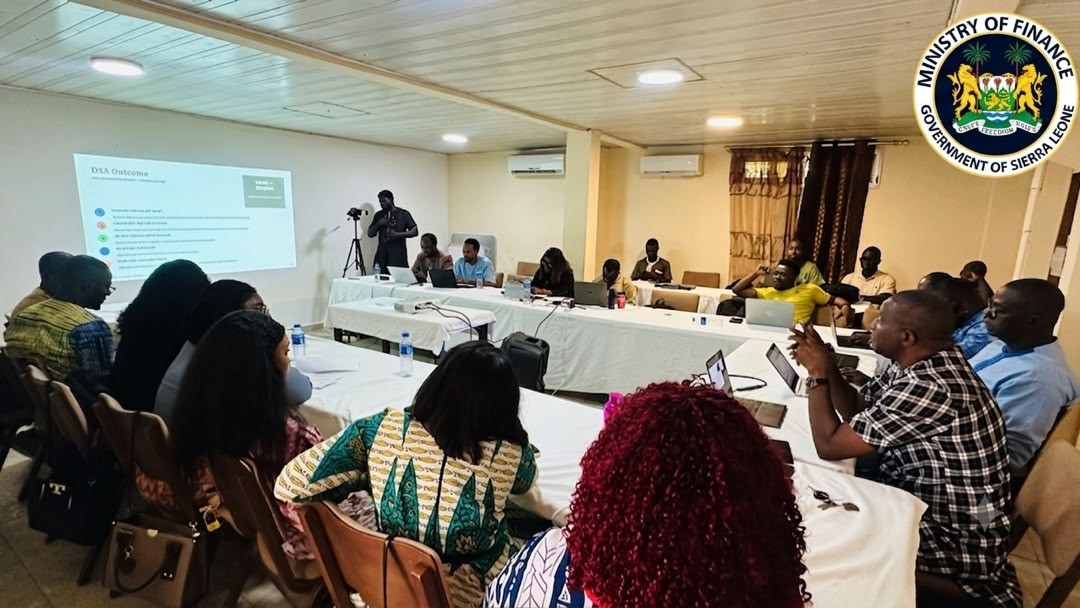
The Public Debt Management Division of the Ministry of Finance, which is responsible for managing public debt and providing policy directives for the country, concluded a two-week workshop on Friday, 24th July 2026, to update the Debt Sustainability Analysis (DSA) and Medium-Term Debt Strategy (MTDS) documents. The workshop, held at Leisure Lodge, Aberdeen, Freetown, aimed to strengthen the country’s debt management framework, reduce the risks and impacts associated with borrowing, and ensure that government borrowing decisions are aligned with sustainable economic growth and development.
During the closing session, the Deputy Director, Santigie Charles Conteh, presented the indicators that guide a country in meeting the required debt sustainability threshold and its capacity to carry debt. He explained that countries are classified into six categories based on these indicators, noting that the latest review shows that Sierra Leone has improved from last year’s assessment of weak debt-carrying capacity to medium debt-carrying capacity. He, however, stressed that the country must maintain this improved status for two DSA cycles before it can be officially classified as having medium debt-carrying capacity. He said achieving and maintaining the medium classification would strengthen the country’s ability to borrow additional resources that could be invested in improving service delivery.
Director Conteh further emphasized that despite the improvement in the country’s debt-carrying capacity, there is still a need for the government to implement key recommendations to sustain the progress. He called for increased domestic revenue mobilization through improved technology in revenue collection, prudent fiscal spending by government, and improvements in the Public-Private Partnership (PPP) architecture to generate more revenue for the state. He also highlighted the need to diversify the economy to promote sustainable economic growth. According to him, the DSA and MTDS exercises will not only support economic growth but will also guide the government’s borrowing patterns and promote prudent spending, ensuring that borrowed resources are directed towards critical sectors such as education, roads, health, and other essential public services, rather than being consumed by debt repayments at the expense of service delivery.
The National Coordinator of the Budget Advocacy Network (BAN), Abu Bakarr Kamara, thanked the Ministry of Finance for ensuring an inclusive process in the development and updating of the DSA and MTDS, involving relevant government institutions and Civil Society Organizations. He said the process was important for strengthening macroeconomic stability and public debt management. He encouraged government to continue strengthening accountability, noting that both documents are essential tools for maintaining debt sustainability and ensuring that borrowed resources are directed towards productive investments that support economic growth, create jobs, and improve public service delivery. He further observed that, as highlighted during the presentation, the repayment value of debt in relation to domestic revenue is not performing as expected, and therefore called on the government to strengthen domestic revenue mobilization, reduce tax exemptions, improve digitalization, and enhance Customs and Goods and Services Tax (GST) revenue collection.
The two-week workshops brought together participants from the Bank of Sierra Leone, Statistics Sierra Leone, the National Revenue Authority, the Ministry of Planning and Economic Development, the Accountant General’s Department, Civil Society Organizations, and staff of the Ministry of Finance. The engagement provided an opportunity for stakeholders to review and update the country’s Debt Sustainability Analysis and Medium-Term Debt Strategy, with the broader objective of ensuring responsible borrowing, strengthening debt management, improving fiscal discipline, and creating the necessary conditions for sustainable economic growth and improved public service delivery.
Credit – MOF Communications
Copyright –Published in Expo Times News on Wednesday, 29th July 2026 (ExpoTimes News – Expo Media Group (expomediasl.com)