




By Aminata Abu Bakarr Kamara
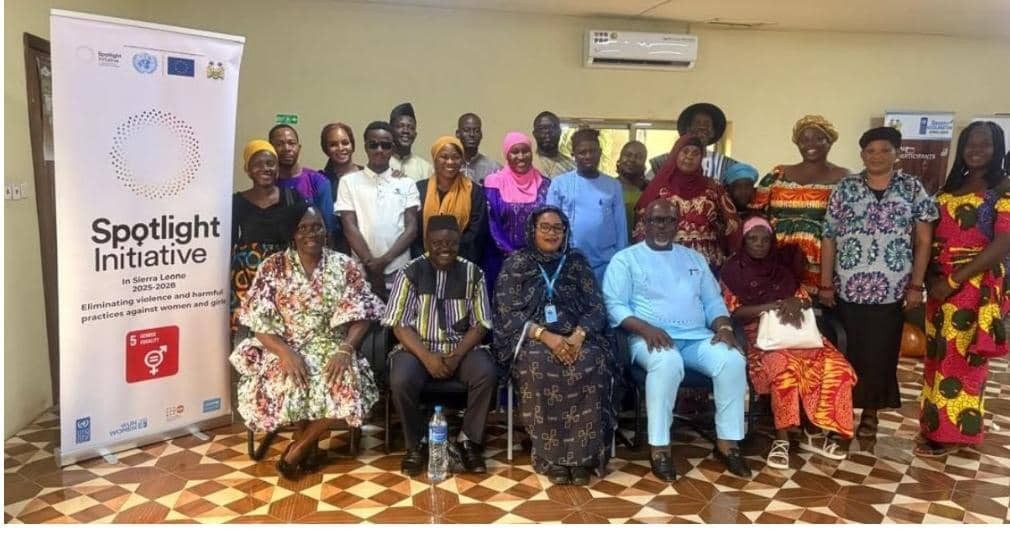
Religious and traditional leaders have been equipped with new skills to challenge harmful social norms and practices affecting women and girls in Sierra Leone following a three-day Mind-Heart Dialogue (MHD) Skills Training organised in collaboration with the African Council of Religious Leaders (ACRL) under the European Union-United Nations Spotlight Initiative.
The training brought together influential community leaders with the aim of strengthening their capacity to engage communities in meaningful conversations around harmful practices, gender equality, human rights and the protection of women and girls.
Participants were introduced to the Mind-Heart Dialogue methodology and the Journey of Change approach, two practical approaches designed to help community leaders facilitate discussions that encourage individuals and communities to reflect on deeply rooted beliefs, attitudes and behaviours.
The organisers said the training was intended to provide religious and traditional leaders with practical tools to help communities examine social norms that contribute to harmful practices, including Female Genital Mutilation (FGM) and child marriage.
According to the organisers, changing harmful social norms requires more than legislation and public awareness campaigns. It also requires sustained engagement with the people and institutions that have significant influence over community attitudes and behaviours.
Religious and traditional leaders occupy an important position within many Sierra Leonean communities. They are often trusted sources of guidance on family, morality, culture and community life, making their involvement critical in efforts to promote the rights and wellbeing of women and girls.
Through the Mind-Heart Dialogue methodology, participants were encouraged to understand how personal beliefs and emotions can influence attitudes and decisions concerning social practices. The approach seeks to create a safe environment where community members can openly discuss sensitive issues, question long-held assumptions and consider alternative behaviours that promote dignity and equality.
The Journey of Change approach further provides a framework through which communities can reflect on the changes they want to achieve and identify practical steps towards those changes.
The training therefore represents an effort to move conversations about harmful practices beyond awareness-raising towards community-led transformation.
FGM and child marriage remain issues of concern in efforts to protect the rights of girls and women. While national and international actors have continued to advocate against practices that expose women and girls to harm, changing attitudes that are deeply embedded in communities can be challenging.
This is where the influence of religious and traditional leaders becomes particularly important.
In many communities, traditional leaders serve as custodians of culture and tradition, while religious leaders provide moral and spiritual guidance. Their positions give them the ability to influence conversations within families and communities and to encourage people to reconsider practices that may negatively affect women and girls.
The organisers stressed that strengthening the capacity of such leaders is essential to promoting positive social norms that protect the rights, dignity and wellbeing of women and girls.
They noted that community leaders can help create spaces where sensitive issues are discussed without fear or stigma, allowing communities to identify the social pressures that often encourage harmful practices.
The training also reflects a growing recognition that sustainable social change cannot be achieved by government institutions and development partners alone. Communities themselves must be involved in identifying the problems they face and developing solutions that are acceptable and sustainable within their local contexts.
For Sierra Leone, this approach is particularly significant because social norms and cultural expectations can influence decisions affecting girls and women, including decisions relating to marriage, education, reproductive health and participation in community life.
By equipping influential leaders with dialogue and community engagement skills, initiatives such as the Mind-Heart Dialogue training seek to strengthen local ownership of efforts to prevent violence and harmful practices.
The EU-UN Spotlight Initiative has been supporting efforts in Sierra Leone and other countries to prevent violence against women and girls and to address the social and structural factors that contribute to such violence.
The initiative places emphasis on coordinated action, community engagement and strengthening institutions and actors working to protect women and girls.
The involvement of the African Council of Religious Leaders also highlights the important role faith-based and community leaders can play in advancing human rights and social development.
Religious leaders, in particular, have the opportunity to use their platforms to promote messages of respect, equality, compassion and protection. Traditional leaders, meanwhile, can influence community-level discussions around cultural practices and encourage communities to embrace traditions that uphold dignity and do not expose women and girls to harm.
However, experts and advocates have repeatedly emphasised that changing social norms is a gradual process. It requires consistent engagement, trusted voices, education and opportunities for communities to reflect on the consequences of harmful practices.
The three-day training is therefore expected to serve as a foundation for continued dialogue at community level.
Participants are expected to apply the skills gained during the training by facilitating conversations within their respective communities and encouraging individuals to reflect on attitudes and practices that may contribute to violence, discrimination and inequality.
The broader objective is to ensure that women and girls can live in communities where their rights are respected, their voices are heard and their wellbeing is protected.
As Sierra Leone continues its efforts to promote gender equality and prevent violence against women and girls, the active participation of religious and traditional leaders could prove vital.
Their ability to influence attitudes, challenge harmful beliefs and promote positive values places them at the centre of efforts to build safer and more inclusive communities.
The Mind-Heart Dialogue training consequently represents more than a skills-development exercise. It is part of a wider effort to encourage communities to examine harmful social norms from within and to empower respected local voices to become advocates for change.
With sustained engagement and commitment from community leaders, government, civil society organisations and development partners, the initiative could contribute to strengthening community action against harmful practices and advancing the protection of women and girls across Sierra Leone.
Copyright –Published in Expo Times News on Monday, 10th August 2026 (ExpoTimes News – Expo Media Group (expomediasl.com)