




By Aminata Abu Bakarr Kamara
The National Sports Authority (NSA) has intensified efforts to strengthen Sierra Leone’s sports sector through international partnerships following a high-level engagement with the Ultimate Sports Group (USG) in London.
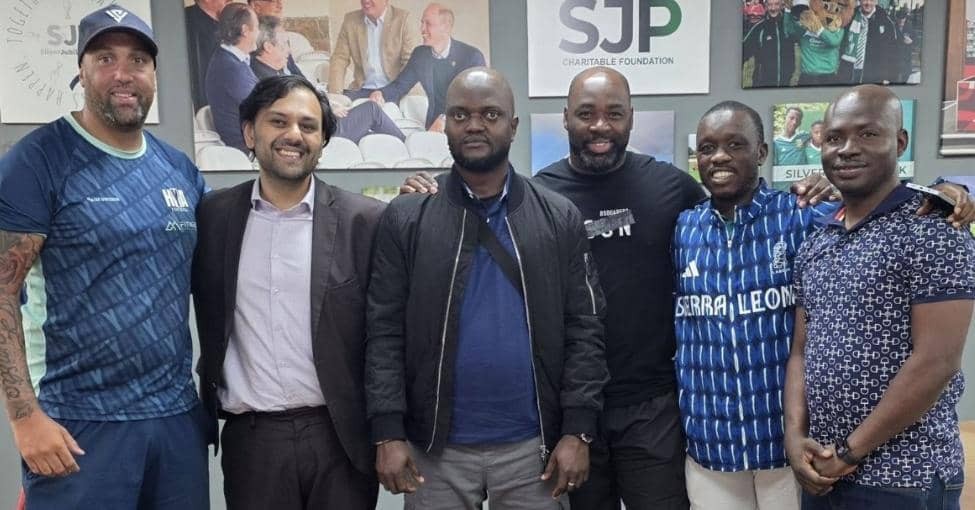
The meeting, held at Silver Jubilee Park, brought together senior representatives of the NSA and USG to explore opportunities for collaboration in coaching, athlete development, sports administration, technical capacity building and international sporting exposure.
The engagement forms part of the NSA’s broader strategy to establish strategic partnerships that can provide Sierra Leonean athletes and sports professionals with access to international expertise, training opportunities and development programmes.
Leading the NSA delegation, Executive Director Mohamed Alphaka Conteh said the Authority was committed to identifying and pursuing partnerships capable of contributing to the long-term development of sports in Sierra Leone.
Conteh said the discussions provided the NSA with important insights into areas including coaching capabilities, technical development of players, pre-season tours, educational programmes and events management.
He said the Authority would continue to explore opportunities that could improve the quality of sports administration and create better pathways for athletes to develop their careers.
“As NSA Executive Director, I am committed to exploring every available opportunity that will contribute to the growth of sports in Sierra Leone. I want to leave a lasting legacy in sports,” Conteh said.
The meeting also featured a presentation by Uthman Odutayo, Founder and Chief Executive Officer of USG, who outlined the organisation’s experience in supporting sporting programmes at national and international levels.
Odutayo explained that USG provides elite-level support to national men’s and women’s football teams, while also working across other sporting disciplines, including basketball and athletics.
He said the organisation brings together experienced sports professionals capable of providing technical assistance and athlete development support to sporting institutions and individuals.
According to Odutayo, potential areas of collaboration include coaching development, player technical improvement, sports management, educational programmes and exposure to international competitions.
He also highlighted scholarship opportunities in the United Kingdom and the United States for athletes, sports administrators and technical personnel.
Such opportunities, if effectively developed into structured programmes, could provide Sierra Leonean athletes and sports officials with access to training and educational experiences that may otherwise be difficult to obtain locally.
For the NSA, the engagement is also viewed as an opportunity to strengthen the professional management of sports and improve the systems supporting athletes from grassroots development to elite competition.
Sierra Leone has produced athletes and sporting teams that have competed internationally, but challenges surrounding training facilities, technical expertise, funding, sports administration and international exposure continue to affect the development of several sporting disciplines.
The NSA’s engagement with USG therefore signals an effort to broaden the range of institutions and organisations contributing to sports development while creating opportunities for knowledge transfer and professional exchange.
NSA Director of Corporate Operations, Alie Sesay, who facilitated the engagement, expressed appreciation to USG for hosting the Sierra Leonean delegation.
Sesay said the discussions had opened promising prospects for athletes and sports professionals in Sierra Leone, particularly in the areas of capacity building and international exposure.
The engagement is expected to provide a basis for further discussions on possible areas of cooperation between the NSA and USG, with the potential to extend beyond football to basketball, athletics and other sporting disciplines.
The NSA’s international partnership drive comes at a time when the Authority is seeking to strengthen Sierra Leone’s position within the international sporting community and create more sustainable development pathways for athletes.
Beyond competition, the proposed areas of cooperation could also contribute to strengthening sports administration by exposing local coaches, administrators and technical personnel to international standards and practices.
The discussions in London consequently represent more than a diplomatic engagement between two sports organisations. They reflect a growing emphasis on partnerships, skills development and knowledge exchange as essential components of building a more competitive sports industry in Sierra Leone.
For the NSA, the immediate challenge will be to translate the discussions and proposed opportunities into concrete programmes that can reach athletes, coaches and sports administrators across the country.
If successfully implemented, the collaboration could provide new avenues for Sierra Leonean sporting talent to access international training, education, professional networks and competitive opportunities, while supporting the country’s broader ambition of developing a stronger and more professionally managed sports sector.
Copyright –Published in Expo Times News on Wednesday, 12th August 2026 (ExpoTimes News – Expo Media Group (expomediasl.com)