




By Emma Black
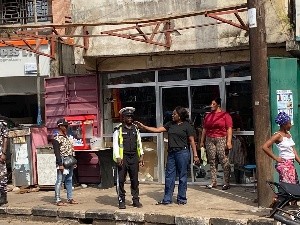
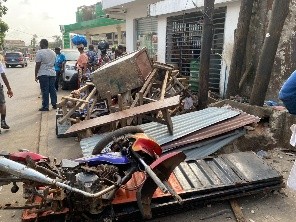
Shops were demolished along Sir Samuel Lewis Road (Aberdeen Road), Byrne Lane (Aberdeen Ferry Road), and Wilkinson Road, leaving dozens of traders without livelihoods and raising serious questions about whose interests Sierra Leone’s laws truly protect.
The demolition exercise was carried out by a joint force involving the Sierra Leone Road Safety Authority, the Sierra Leone Police, and the military. The operation targeted traders operating along busy commercial routes, despite many of them having recently paid fees to the Freetown City Council to conduct business in those same locations.
According to statistics gathered at the scene, about 70 percent of the affected traders were women, most of them breadwinners supporting children, elderly parents, and extended family members who rely entirely on daily trading for survival.
For traders along Aberdeen Road and Wilkinson Road, the exercise felt less like regulation and more like punishment carried out without warning, consultation, or alternatives. Standing beside the remains of his demolished shop, Amadu, a father of five, described the experience as devastating.
This is inhuman, he said. I was laid off from my job, so I turned to trading to survive. Yesterday, they destroyed my shop and stopped my business. Now I have no income and no place to work.
He explained that his entire household depends on his daily sales for food, rent, and school needs.
Nearby, a woman trader broke down in tears as she recounted how her shop was destroyed without notice.
I am a single parent with three children, she said, they are all in school. This shop is how I feed them, pay school charges, and buy learning materials. Now I don’t even know where I will get money today.
Many traders told Expo Times that they had recently paid annual trading and city council fees to the FCC. According to them, fees ranged from Le 150 to Le 2,000, depending on the size of the shop and the type of goods sold. Some said they made these payments only days or weeks before the demolition.
We paid the FCC to sell here, one trader said. After one week, another government authority came with police and soldiers to remove us from the same place we paid for. Who is cheating who?
Traders also questioned why shops that had existed for three to four years without incident were suddenly declared illegal, while similar roadside structures remain untouched elsewhere in the city.
At the centre of the crisis is a long-standing and unresolved issue Freetown does not have enough markets to accommodate its growing number of traders.
The Aberdeen Community Market, traders explained, was originally built to accommodate about 1,000 traders, but now serves more than 6,000. Other markets across the city face similar overcrowding.
This problem has existed since the 1980s, a senior trader said. The population keeps increasing, but the markets remain the same size. Street trading became a survival strategy, not a choice.
Many of the affected traders support large families. Some took microcredit loans to start their businesses loans that must be repaid whether or not they have a place to sell.
Sierra Leone’s high unemployment rate, especially among young and educated people, continues to push thousands into informal trading. Others migrate from rural areas to Freetown in search of opportunity, only to face eviction once they establish a small livelihood.
Traders warn that destroying livelihoods without alternatives will worsen already serious social problems, look at the rate of drug abuse in this country, one trader said. People are linking it to unemployment. If there are no jobs and no business opportunities, what do you expect will happen?”
Efforts to obtain comments from the Freetown City Council were unsuccessful at the time of publication. The Council declined to respond to questions about why traders who had already paid fees were removed, whether compensation or relocation would be provided, and where displaced traders are expected to go.
This silence has left traders feeling abandoned and voiceless. Where does the government want us to do business?” one woman asked. We are not criminals. We are just trying to survive.
Beyond economic loss, traders raised concerns about health and climate impacts, particularly extreme heat. Many roadside traders had installed temporary rooftops not to obstruct traffic, they insist, but to protect themselves from prolonged exposure to the sun. With rising temperatures across Sierra Leone, traders report increased cases of headaches, dehydration, skin rashes, and heat exhaustion.
These rooftops protected us from the heat, one trader explained. Now they are gone, and we are exposed again. This affects our health and our ability to work.
Traders also noted that many invested hundreds or even thousands of dollars over time to build their stalls. The removal of rooftops and structures without compensation has deepened their losses.
Street trading has long been a complex issue in Sierra Leone. But for those affected by yesterday’s demolitions, the issue is no longer theoretical it is immediate, personal, and devastating.
When laws are enforced without protecting the poor, when fees are collected without services, and when livelihoods are destroyed without alternatives, justice becomes selective, as rubble lines the streets of Aberdeen and Wilkinson Road, one question remains unanswered Who do Sierra Leone’s laws truly protect the city, or the people who keep it alive?
Copyright –Published in Expo Times News on Friday, 16th January 2026 (ExpoTimes News – Expo Media Group (expomediasl.com)