



By Thaimu T Kamara
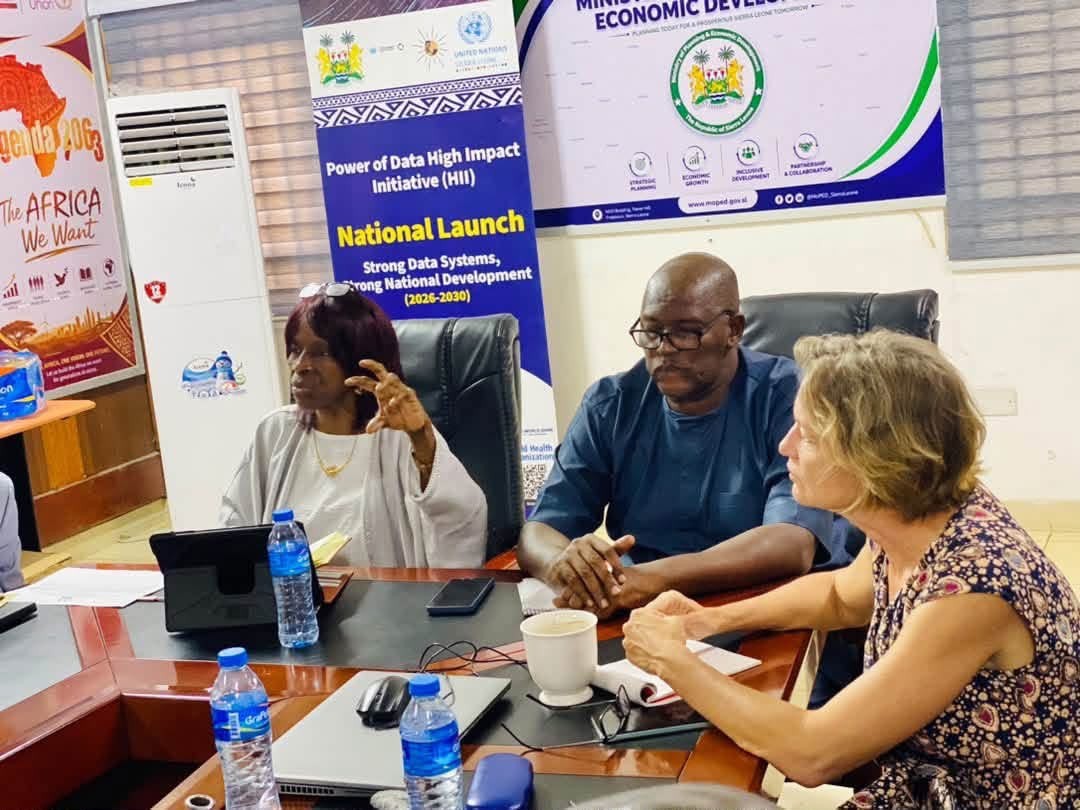
The Ministry of Planning and Economic Development (MoPED) has convened the third meeting of the National Authorising Committee (NAC) to review proposed development projects under Sierra Leone’s participation in the ECOWAS Fund for Regional Stabilisation and Development (FRSD), with a focus on interventions targeting vulnerable communities.
The meeting, held on Monday, 16 November 2026, at the Ministry’s Conference Room in Freetown, brought together representatives of government ministries, development partners, technical experts and civil society organisations to assess proposed interventions and identify projects capable of delivering sustainable development outcomes.
The meeting was chaired by the Minister of Planning and Economic Development, Kenyeh Barlay, and attended by FRSD technical consultants Veerle Van Waesberghe and Steffen Horn, who are in the country to support the technical assessment of proposed projects.
In her opening remarks, Minister Barlay emphasised the importance of selecting appropriate target districts and prioritising projects that would deliver meaningful results for vulnerable populations. She recalled that Kono, Kailahun and Pujehun had initially been identified based on their vulnerability levels and the presence of development partners.
However, she encouraged committee members to consider whether additional districts could benefit, while cautioning against spreading limited resources across too many locations.
The Minister also called for greater attention to the challenges facing young people, particularly in agriculture, technical and vocational education and training (TVET), mental health, drug rehabilitation and alternative learning opportunities. She urged ministries to develop practical, properly costed proposals with measurable outcomes.
A major issue discussed was the minimum project allocation of approximately €1 million. Members were encouraged to consider combining related interventions across districts to achieve the required funding threshold and maximise impact.
Providing guidance on the assessment process, Van Waesberghe said the technical team was focused on identifying projects capable of delivering the greatest development impact with available resources. She encouraged ministries to submit focused proposals aligned with the fund’s priorities.
Horn outlined the assessment criteria, which include geographical accessibility, the scale of community needs, the availability of credible implementing partners and alignment with eligible sectors such as agriculture, education, health, climate, water and sanitation, and social infrastructure. He stressed that proposals must meet the minimum funding requirement and demonstrate a significant infrastructure component.
The assessment will also consider sustainability, implementation arrangements, expected results, cost efficiency and alignment with government priorities.
During the meeting, the Ministry of Technical and Higher Education presented proposals covering vocational skills development for young people in border communities, renewable energy and clean cooking, and solar energy for Kono University of Science and Technology.
The skills development initiative seeks to equip out-of-school young people, particularly young women and persons with disabilities, with practical skills in sewing, carpentry and electrical installation. The proposal incorporates the Dual Apprenticeship Policy, which provides for 70 per cent practical training and 30 per cent theoretical learning.
The Ministry also proposed establishing renewable energy and clean cooking hubs at three Government Technical Institutes, alongside a solar mini-grid for Kono University of Science and Technology to reduce electricity costs, strengthen academic operations and provide practical learning opportunities.
The Ministry of Basic and Senior Secondary Education presented interventions aimed at expanding technical education opportunities and promoting girls’ participation in Science, Technology, Engineering and Mathematics (STEM). The proposals seek to strengthen technical education pathways and improve access to practical skills and recognised qualifications.
The Ministry of Social Welfare outlined proposals addressing drug rehabilitation, sexual and gender-based violence, children in street situations and child marriage. The interventions include improving rehabilitation facilities, providing psychosocial support, strengthening livelihood opportunities and facilitating the reintegration of vulnerable children and survivors into their communities.
Representatives also highlighted the importance of supporting survivors of gender-based violence through vocational training, financial inclusion, education and economic empowerment.
Meanwhile, the Ministry of Local Government and Community Affairs presented a proposal to strengthen customary justice systems through the professionalisation of Paramount Chiefs’ courts. The intervention seeks to improve court infrastructure, strengthen the capacity of traditional authorities and promote accountability and respect for human rights.
The Ministry of Youth Affairs also presented proposals on aquaculture and integrated youth farming, focusing on fish production, poultry and vegetable cultivation as opportunities for youth employment and income generation.
During the discussions, civil society representative Charles Kobai recommended developing visual prototypes of proposed facilities to help ministries better understand infrastructure requirements, equipment needs and potential implementation costs.
In response, Minister Barlay called for detailed cost breakdowns, particularly for infrastructure-related proposals, to ensure their feasibility and effective use of available resources.
At the conclusion of the meeting, the FRSD technical consultants thanked participating ministries for their contributions. Van Waesberghe disclosed that the technical team would undertake preliminary screening of the proposals before ministries proceed with detailed submissions.
Horn added that the assessment criteria and standard proposal templates would be shared with ministries, alongside written feedback to guide improvements. The technical team will also engage potential implementing partners to identify opportunities for collaboration and avoid duplication.
The meeting ended with a renewed commitment to developing focused, realistic and sustainable interventions that address the needs of vulnerable communities while supporting Sierra Leone’s national development priorities.
However, the proposed projects remain under technical assessment, with no final project selection or financing approval announced at the meeting.
Copyright –Published in Expo Times News on Monday, 23th November 2026 (ExpoTimes News – Expo Media Group (expomediasl.com)