


By Amara Thoronka
It was the late globally acclaimed South African President Nelson Mandela who said that “education is the most powerful weapon you can use to change the world”, while he literally added that “destroying any nation does not require the use of atomic bombs, or the use of long-range missiles; it only requires lowering the quality of education and allowing cheating in examinations by students.” Going by Mandela’s viewpoint, it suffices to say that education can only be a powerful change weapon when it is accessible and of high quality.
Sierra Leone is a third world nation with perennial economic challenges. Majority of the population struggle with poverty and its vices; and because of such circumstance, a good number of parents and guardians cannot afford school fees and other charges for their children.
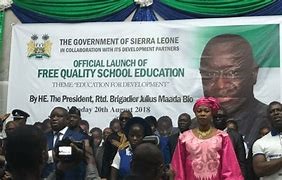
Owing to the importance of education that cannot be overemphasized, and the poverty challenging reality of Sierra Leone, government is central in realizing accessible and quality education for all. Top in President Julius Maada Bio’s 2018 election manifesto was free quality education in all public schools nationwide. The initiative was perceived by his political opponents as unrealistic and stillborn. Fast forward, the former military general was elected and sworn-in as President of Sierra Leone. In August 2018, just three months into his first-term presidency, President Bio officially launched the commencement of a free quality education project, marking a step to fulfilling his topmost manifesto promise.
The landmark national education project was announced as a package that covers tuition fee, public exam fee, core textbooks, school feeding, among others.
Progressive impacts
Since the introduction of the project in 2018, thousands of pupils in all public schools have been accessing learning without paying tuition fee and public exam fee. These crucial financial burdens on poor families, covered by government, have caused several children who had dropped out or never attended school to access learning in all public schools in the country, thereby realizing astronomic increase in access or enrolment.
The project has steadily increased the number of public exams’ candidates, causing more students to transition from primary school to junior secondary school; from junior high school to senior high school; and from senior high school to university. This may also be linked to the proliferation of tertiary leaning institutions across the country. There are now more people taking and passing the West Africa Senior School Certificate Examination (WASSCE) than ever before. There are definitely challenges which will be discussed later, but having more kids in school is laudable.
As a way of encouraging pupils, especially those from poor families, to stay in school and concentrate, the government has been rolling out school feeding programs, particularly in some deprived communities. The Ministry of Basic and Senior Secondary Education has always maintained that the said school feeding program has had positive impacts in school retention and pupil concentration.
Mitigating the wide teacher-students ratio created by the mass intake in public school due to some financial obligations covered by the free quality education project, more teachers have been recruited. More schools and classrooms have also been constructed to meet the ever-growing demand influenced by the project.
Moreover, public examinations’ results, especially that of the Basic Education Certificate Examination (BECE) – the transition public exam into senior high school, has consistently been published on time under the dispensation of the President Bio government. Before President Bio assumed office, pupils who took the BECE had to forfeit the whole of first quarter of the academic year at senior high school because the results of the said transitional public exam were usually published around mid or late first term of the school year. This is now history as pupils transitioning to senior high school now attend the complete three-term academic year.
Talking about public results, there is always the excitement and anxiety among parents and their kids to know the outcome of public exams’ results. What used to happen was that parents or self-sponsored students would have to buy scratch cards and pay internet charges to access such results online. While Dr. David Moinina Sengeh, now the country’s chief minister, was Minister of MBSSE, an electronic result checker was developed. The landmark innovation provides free access to public exams’ results. All that is required is to send a free text message requesting for a student’s result and the result will be freely sent. This has taken off a huge financial burden on poor parents.
Also, before rolling out the free quality education project, President Bio disintegrated the previous Ministry of Education, Science and Technology into two. We now have the Ministry of Basic and Senior Secondary Education (MBSSE) which covers pre-primary, primary, and junior and senior high school. The MBSSE implements the free quality education project. There is also the Ministry of Technical and Higher Education that covers higher leaning institutions like universities, colleges and technical and vocational institutions. This may be connected to the several progressive indicators in the basic and senior secondary education in the country as basic education now has a stand-alone ministry.
Challenges and the way forward
Despite the significant transformative developments in the sector, there are still enormous challenges weakening the quality component of the free quality education project. The free component has essentially increased access to basic education, but certain challenges adversely affect the very essence of academic education which is to adequately mould and train people to be viable solutions to existing and emerging problems of society.
Teaching methodology and pupil assessment is still a challenge. My occasional face-to-face engagement with students of different public schools on some basic subject areas has kept me asking what is really being taught in school. We should be moving away from this very long writing on boards with time-constrained explanations. Some teachers still fill up a board twice or thrice in a single lesson before giving scanty incomprehensible explanations. Practical driven subjects like creative practical arts, agriculture, physics, chemistry, biology, among others, are being graded mainly by written exams and money or items solicited or extorted from pupils. Imagine the implications of such on quality education! Government, through MBSSE, should intensify monitoring on how teachers instruct learning and conduct assessments.
Not having functional library and laboratory coupled with inadequate teaching and learning materials in public schools continue to be big challenges. Public schools, especially in the provinces, are still constrained in having the requisite materials for effective learning. Not having prescribed texts coupled with using chalk and blackboard in this 21st century makes learning constraining and ineffective. Several public schools are either without libraries and laboratories or they are there but not functional. Imagine science students in many schools not having well-equipped laboratories to do their practicals! Government and its partners in education should provide adequate teaching and learning materials, facilitate the sophistication of libraries and science laboratories as such areas are inevitably crucial in realizing quality learning. Also, Government should act on the cries of deprived rural communities which have been crying for either the establishment of schools, especial high schools, in their communities or assistance with school accommodation facilities like furniture and more classrooms.
Also, there is very little attention given to sports and innovation in schools. The physical education, science and creative practical arts departments in schools should be trained and empowered to spot students with exceptional sporting and/or innovative abilities that may be of huge benefits to the said students and the country. The school system is pivotal in training and identifying people with great abilities that have the potency to fly high the flag of the country globally in the areas of sports, innovation and science. Remember, not all students are biologically designed for academia. Some can be exceptional massive in sports and the creative industry. The school system should reflect on all walks of life.
Teachers’ condition of service is another challenge. It is worth emphasizing that no matter how progressive a government policy is on education, it will never realize its goal without teachers because they are the learning or training instructors in schools. They have been consistently agitating for better condition of service in the midst of inflation and high cost of living. The President Bio government has been making efforts to increase teachers’ salaries but they have repeatedly said such salary increase has never been enough to mitigate inflation impacts. One effective way government can handle this challenge is reassessing teachers, put them on grades reflecting their credentials and pay them the same amount received by civil/public servants in those salary grades.
Incompetence of some teachers handling complex subject areas continues to be an issue that successive government has not paid much attention to. As a nation, we have placed so much exclusive focus on acquiring academic certificates to a point that it is the only prerequisite used by several people and institutions to determine the capability of someone to do something. There is a great difference between qualification and competence. While qualification focuses on academic or skill certificates, competence is about the practical ability of someone to do a given job or task. Many students in higher institutions bribe their way through. We have heard severally about sex for grade, bribery, change of grades, among others, in our tertiary educational institutions. It is possible that many of the teachers or lecturers in our schools and colleges are products of academic fraud, but because they have academic certificates, they are qualified to teach or lecture. Even for those who genuinely acquired their certificates, not all of them are competent to teach. To instruct effective learning is a special ability. There are people with great intellect and knowledge on a give subject but do not have the ability and skill to pass on knowledge. I suggest that government undertakes a nationwide teacher assessment and validation exercise where teachers’ subject competence and classroom delivery style are assessed. This may sound huge but it has lasting positive impact on the country’s education and development.
That said, even though this second tenure of President Bio’s administration has agriculture as a flagship, and has also committed to continuing with the free quality education project, it would be a whole good for the government and the people of this country if education is giving more attention as development in all sectors revolves around it. Let’s have a competence-based or problem-solving educational system, and not one that focuses more on certificate acquisition and proficiency in English language.
Copyright –Published in Expo Magazine, February Edition, Vol.2, No.2, 2024 (ExpoTimes News – Expo Media Group (expomediasl.com)