




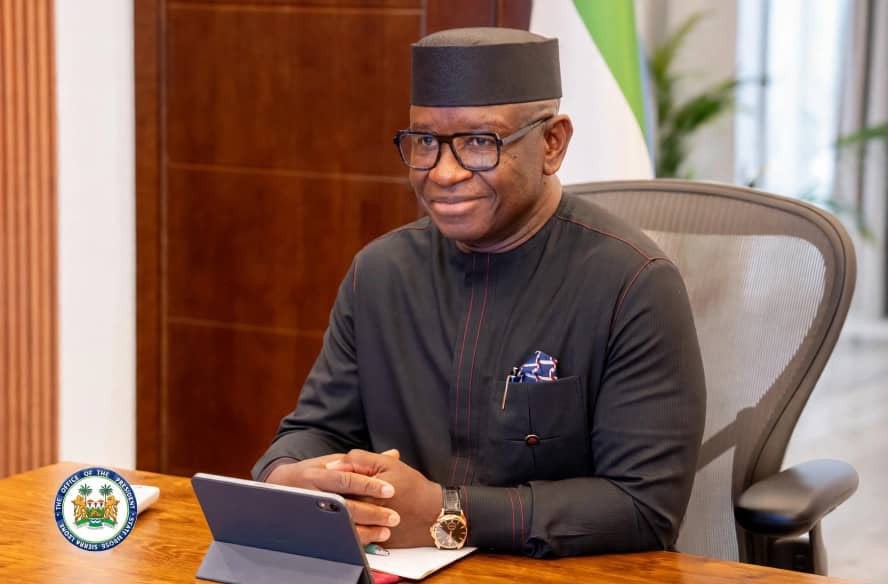
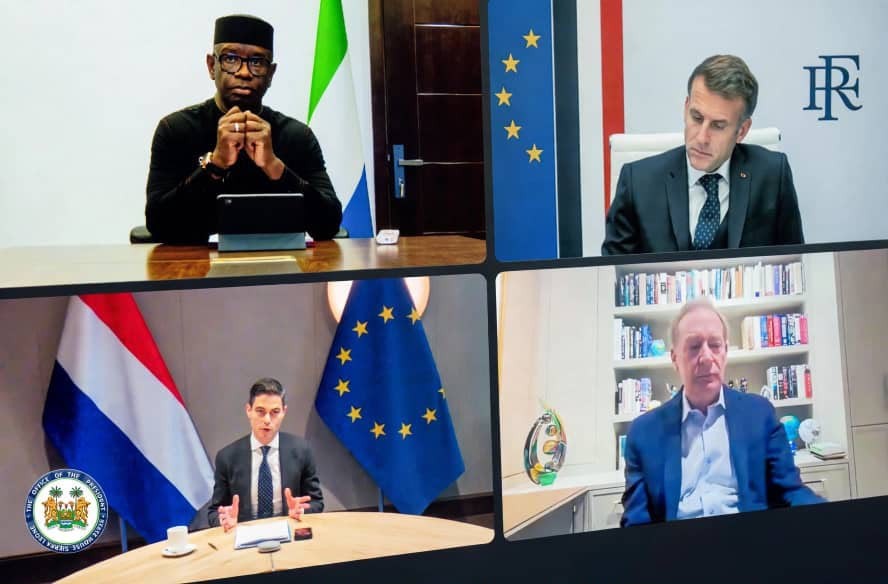
President Julius Maada Bio has called for stronger international cooperation on the security and governance of advanced artificial intelligence (AI), urging global leaders to give African countries and other developing nations a meaningful role in shaping standards for the technology.
President Bio made the call on Monday, November 9, 2026, while addressing a high-level virtual meeting on Strengthening International Cooperation on Frontier Model Security, convened by French President Emmanuel Macron.
He maintained that the development and deployment of artificial intelligence must remain under human direction, oversight and control, stressing the need for international safeguards to address emerging risks associated with increasingly advanced AI systems.
The President recalled that Sierra Leone endorsed the Call for Control of Frontier AI Models during the AI Middle Powers Roundtable at the United Nations General Assembly in September 2026. The roundtable was co-hosted by Kenya and Finland and initiated by Finland and Norway.
He said the virtual meeting provided an opportunity to translate those commitments into practical measures for strengthening international cooperation on frontier AI security.
Addressing Sierra Leone’s national preparations for artificial intelligence governance, President Bio disclosed that the country had completed its National AI Readiness Assessment, which would inform the development of its first National AI Strategy.
He explained that the government was exploring opportunities to use artificial intelligence to improve agriculture, healthcare, education and public service delivery, while strengthening digital infrastructure and regional cooperation through the Economic Community of West African States (ECOWAS).
He also highlighted the proposed Regional Data Embassy Framework, which seeks to expand access to shared digital infrastructure while safeguarding national jurisdiction and control over data.
“As we advance these efforts, we recognise the importance of building safety, security and accountability into our approach from the outset,” President Bio stated, emphasizing the need to balance the opportunities presented by artificial intelligence with appropriate safeguards against emerging risks.
On international cooperation, the President identified common standards for evaluating the safety and security of advanced AI models, clear accountability for developers and deployers, and effective mechanisms for reporting serious incidents and sharing information on emerging threats as essential areas requiring attention.
He stressed that independent evaluation, transparency, effective oversight and coordinated responses were necessary, particularly because the benefits and risks associated with increasingly capable AI systems extended beyond national borders.
“No country can adequately address these challenges on its own. Sovereignty does not mean doing everything alone. It means choosing the terms on which we work together,” President Bio said.
He further argued that global AI governance must be inclusive, insisting that African countries and other developing nations should not merely adopt standards established elsewhere but should participate meaningfully in developing them.
The President called for increased investment in scientific expertise, institutional capacity and evaluation tools to enable developing countries to assess advanced AI systems deployed within their jurisdictions and contribute effectively to international governance arrangements.
He also welcomed the proposed Paris Declaration, particularly its emphasis on common evaluation standards, clear accountability and international cooperation in reporting serious AI-related incidents.
However, he called for its commitments to be translated into practical measures through credible evaluation mechanisms, timely information-sharing and stronger national and regional capabilities.
President Bio reaffirmed Sierra Leone’s readiness to work with international partners to ensure that artificial intelligence advances without compromising human safety, national sovereignty or human control.
The high-level virtual meeting brought together several world leaders and senior government representatives, including United Kingdom Prime Minister Andy Burnham, Canadian Prime Minister Mark Carney, Japanese Prime Minister Sanae Takaichi, Norwegian Prime Minister Jonas Gahr Støre, Netherlands Prime Minister Rob Jetten, Finnish President Alexander Stubb, United States Secretary of the Treasury Scott Bessent and Bahrain’s Crown Prince and Prime Minister Salman bin Hamad Al Khalifa.
Senior representatives of leading technology companies also participated, including Microsoft President Brad Smith, OpenAI Chief Executive Officer Sam Altman and Mistral AI Chief Executive Officer Arthur Mensch, reflecting the role of collaboration between governments and the technology industry in addressing the security and responsible development of artificial intelligence.
Copyright –Published in Expo Times News on Wednesday, 11th November 2026 (ExpoTimes News – Expo Media Group (expomediasl.com)