




Against the backdrop of one of Europe’s most influential gatherings on sustainable development, Sierra Leone’s Vice President, Dr. Mohamed Juldeh Jalloh, stood shoulder to shoulder with some of the world’s most influential political and financial leaders at the Hamburg Sustainability Conference, demonstrating that the concerns of smaller developing nations deserve a central place in global decision-making.
From the grandeur of Hamburg’s historic City Hall, where heads of state, ministers, multilateral development bank presidents and senior UN officials gathered for the official leaders’ photograph, to the conference halls where the world’s toughest economic and geopolitical challenges were debated, Vice President Juldeh Jalloh moved confidently among global policymakers, engaging counterparts and reinforcing his country’s growing diplomatic profile.
His participation alongside German President, Frank-Walter Steinmeier, World Trade Organization Director-General, Dr. Ngozi Okonjo-Iweala, Asian Development Bank President, Masato Kanda, and other international leaders, reflected Sierra Leone’s increasing visibility in conversations shaping the future of sustainable development, economic resilience and international cooperation.
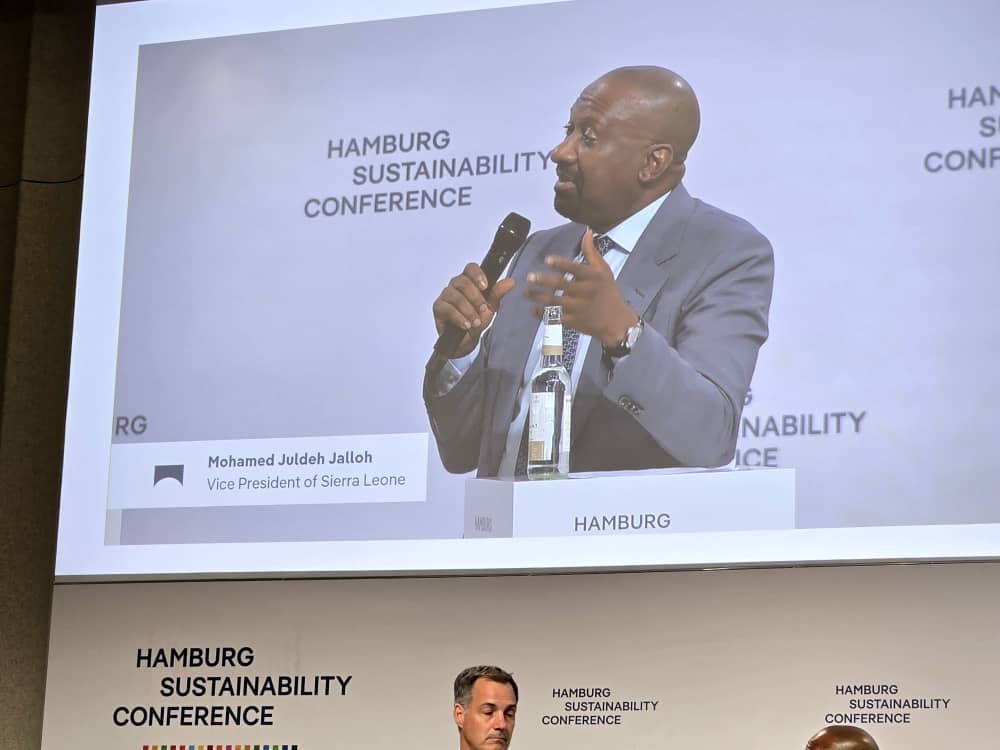
The defining moment of Dr. Juldeh Jalloh’s engagement came during the high-level panel, “Navigating the Hormuz Crisis: Forging a Collective Response,” convened immediately after a keynote address by United Nations Deputy Secretary-General, Amina J. Mohammed.
Sharing the stage with Germany’s Federal Minister for Economic Cooperation and Development, Reem Alabali-Radovan, UNDP Administrator, Alexander De Croo, UK Minister of State for International Development and Africa, Baroness Jennifer Chapman, and African Development Bank President Dr. Sidi Ould Tah, the Vice President delivered one of the session’s most compelling interventions.
Speaking with the authority of both a former United Nations governance and security expert and the leader of an import-dependent African economy, he transformed what might have remained a discussion about Hormuz, the Middle East shipping routes, into a powerful argument about global inequality.
“For the Global South, an oil shock is never just an oil shock. It becomes a food shock, a fiscal shock, and ultimately a human development shock,” he observed, explaining how disruptions in strategic trade corridors rapidly drive up the cost of fuel, food, fertiliser, electricity and transport across vulnerable economies.
His remarks resonated throughout the forum as he challenged the international community to view food and energy security not simply as domestic priorities but as essential foundations of global stability and resilience.
Beyond diagnosing the problem, Dr. Juldeh Jalloh distinguished himself by offering a practical roadmap for reforming the international financial system. He urged multilateral development banks, including the African Development Bank and the World Bank, to establish a Global South Shock Absorption Facility, capable of providing rapid, flexible financing to countries hit by geopolitical and supply chain disruptions before crises spiral into humanitarian emergencies.
Drawing comparisons with existing climate financing mechanisms, he argued that the world must move beyond reacting after disasters occur and instead invest in resilience before they unfold. It was a proposal that elevated Sierra Leone from participant to policy contributor, underscoring the country’s determination to help shape solutions rather than merely appeal for assistance.
As delegates left the conference hall, the impression was unmistakable: amid a gathering dominated by the world’s largest economies and leading international institutions, Sierra Leone’s Vice President had not only held his own but had emerged as one of the conference’s strongest advocates for a more equitable and resilient global economic order.
Copyright –Published in Expo Times News on Wednesday, 1st July 2026 (ExpoTimes News – Expo Media Group (expomediasl.com)