



By Aminata Abu Bakarr Kamara
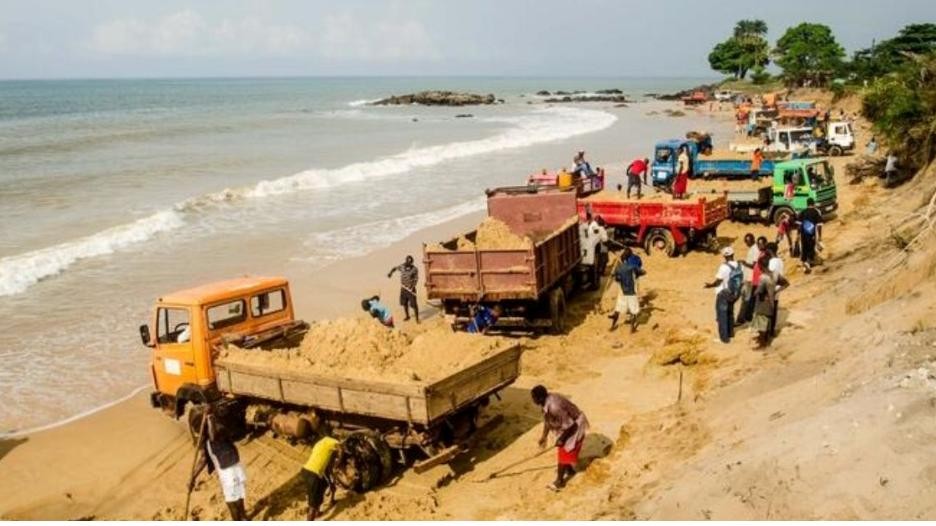
Communities along the Lungi coastline, particularly between Yongoro, Mahera, and Benkeh, are facing increasing environmental and structural threats as unchecked sand mining continues to accelerate coastal erosion.
Recent findings indicate that large-scale sand extraction is significantly altering the natural shoreline, with serious consequences for homes, livelihoods, and local ecosystems. Residents and local authorities warn that the situation is worsening, as the coastline steadily retreats and once-stable land disappears into the sea.
According to research presented by the Director of Research at the Urban Research Centre, Braima M. Koroma, Sierra Leone’s shoreline has retreated by an average of 53 metres since 2000. In the Lungi axis, this trend is becoming more visible, with several communities already experiencing direct impact.
The study, titled “Assessment of the Scale and Impact of Sand Mining on Selected Coastal Communities in Sierra Leone,” identified Yongoro, Mahera, Benkeh, and surrounding areas as key sand extraction zones, where activities continue largely unchecked.
Koroma further revealed that an estimated 1.25 million cubic metres of sand are extracted annually across affected coastal communities, contributing to environmental degradation and increased vulnerability of shoreline settlements.
In Yongoro, section chief Pa Alimamy Kargbo described the situation as alarming, noting that significant portions of land that once supported homes and livelihoods have already been lost.
“Areas that used to be hundreds of feet away from the water are now completely submerged,” he said. “People are beginning to sell their land because they fear what will happen next.”
In Benkeh, headman Aruna Kamara echoed similar concerns, warning that the rate of sand extraction is placing the community at serious risk.
“Our shoreline is changing very fast,” Kamara said. “If this continues, we will lose more land and even homes. The community depends on this land, and we are worried about the future.”
At Mahera, stakeholder Ibrahim Kargbo highlighted the economic dilemma facing residents, noting that while sand mining provides income, it is also driving long-term destruction.
“Many people depend on sand mining to survive, but at the same time, it is destroying our environment,” he explained. “We need alternatives, because what is happening now is not sustainable.”
The environmental impact extends beyond land loss. Coastal ecosystems, including mangroves, are also under pressure, reducing natural protection against wave action and increasing the risk of flooding in nearby communities.
Local stakeholders say the largely informal nature of sand mining has made regulation difficult. While the activity provides income for many residents, it is also exposing workers to risks and contributing to long-term environmental instability.
There are also growing concerns about how revenues from sand mining are managed. Head of Climate Financing at the Ministry of Finance, Sellu McCarthy, noted that payments made by sand miners to communities and local councils are not always properly coordinated with government systems.
“Government is already supporting councils financially, yet extractors are also paying at the local level. This raises concerns about accountability and sustainability,” he said.
He recommended greater involvement of the National Revenue Authority in monitoring such payments to ensure transparency and better oversight.
As erosion intensifies across the Lungi coastline, calls are growing for stronger regulation, improved coordination among authorities, and sustainable alternatives to sand mining that can protect both livelihoods and the environment.
For residents of Yongoro, Mahera, and Benkeh, the issue is no longer distant—it is unfolding in real time, with land, homes, and community spaces steadily being claimed by the sea.
Copyright –Published in Expo Times News on Wednesday, 22nd April 2026 (ExpoTimes News – Expo Media Group (expomediasl.com)