


Baomahun Gold Mining to Commence Operations Soon
By Emma Black
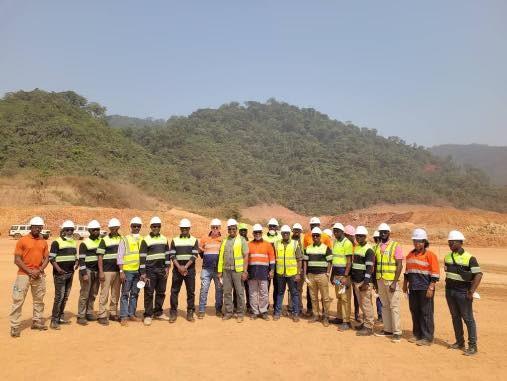
The Ministry of Mines and Mineral Resources, in collaboration with the National Minerals Agency (NMA), has carried out a high-level inspection of the Baomahun Gold Project as the country moves closer to full-scale mining and commercial gold production.
The site visit took place on Tuesday, 27 January 2026, across Valunia and Kunike Barina Chiefdoms in the Bo and Tonkolili Districts. It was led by the Minister of Mines and Mineral Resources, Julius D. Mattia, alongside senior NMA officials, including directors, inspectors, and technical specialists.
During the visit, Project Director of FG Gold Mining Company, Bolaji Okubajo, presented an overview of the project’s development status, operational plans, and sustainability strategy. He reaffirmed the company’s commitment to responsible mining, strong safety standards, and local content development in line with Sierra Leone’s national priorities.
Mr. Okubajo disclosed that a substantial share of the project’s construction and operational contracts has been awarded to locally registered and wholly Sierra Leonean-owned companies. He noted that more than half of FG Gold’s annual expenditure on goods and services is retained within the country, with preference given to host communities, national suppliers, and ECOWAS-based partners.
On infrastructure and technology, the Project Director highlighted the use of modern processing plant technology supported by reputable international partners. These include engineering and construction management firms, integrated battery-powered energy systems, explosives suppliers, geo-technical experts, tailings storage facility designers, and globally recognized equipment manufacturers. He said the adoption of advanced technology has significantly reduced operational risks and potential project delays.
In terms of employment, FG Gold currently employs about 300 staff directly, with projections to exceed 500 direct employees once operations fully commence. Including contractors, the total workforce at the site stands at approximately 1,400 and is expected to peak at around 2,000 during the construction phase. Mr. Okubajo added that the company has reduced its expatriate workforce from 11 percent to 9 percent while increasing opportunities for national professionals and expanding female participation.
The company also outlined a range of completed and ongoing community development initiatives. These include skills training programmes for young people, with 94 community youths completing driving courses 60 percent of them women; four women trained as heavy-duty equipment operators, and more than 300 former artisanal miners absorbed into employment with FG Gold and its contractors.
Community projects implemented between 2022 and 2025 include the construction of the St. Josephine Bakhita Primary School, rehabilitation of the Baomahun Health Centre, award of 23 tertiary scholarships under the Valunia Education Fund, drilling of seven water boreholes, renovation of a local mosque, and the ongoing construction of a community town hall. The company has also carried out road grading and rehabilitation works spanning 68 kilometres from the mine site to Matotoka.
Addressing stakeholders during the inspection, Minister of Mines Julius D. Mattia described Baomahun as one of Sierra Leone’s most highly mineralized gold zones. He recalled that exploration activities conducted before the Ebola outbreak had already confirmed the area’s significant gold potential.
The Minister explained that the Government granted FG Gold a mining licence to support the transition from artisanal mining to large-scale industrial mining, a move aimed at maximizing national revenue, improving environmental management, and delivering long-term benefits to host communities. He disclosed that the company has mobilized over US$600 million in financing to develop the project.
The inspection team toured key installations, including workers’ accommodation facilities, processing plants, and critical infrastructure such as the ball mill, SAG mill, carbon-in-leach facilities, and power systems. Minister Mattia said the visit allowed Government officials to observe firsthand how a greenfield mining project is being developed from inception to production.
He expressed confidence that the Baomahun Gold Project will produce its first commercial gold by December 2026, noting that the deposit contains an estimated 4.6 million ounces of mineralization, with proven reserves exceeding 2.1 million ounces.
According to the Minister, the project is expected to generate employment, promote skills and technology transfer, increase national revenue, and enhance Sierra Leone’s competitiveness in the sub-region, particularly against the backdrop of rising global gold prices.
He further reaffirmed the Government’s commitment to maintaining a stable and transparent mining regulatory framework that attracts responsible investment while ensuring that mining contributes meaningfully to economic growth through royalties, taxes, and other revenue streams.
The Baomahun Gold Project is projected to become one of Sierra Leone’s flagship large-scale gold mining operations, with anticipated long-term socio-economic benefits for host communities and the nation as a whole.
Copyright –Published in Expo Magazine, March-April 2025 Edition Vol.4, No.1, (ExpoTimes News – Expo Media Group (expomediasl.com)