



By Kadiatu A Turay.
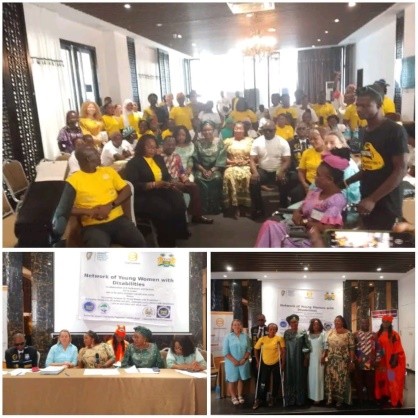
The Young Women with disabilities national advocacy engagement has brought together activists, government officials, community leaders, and development partners in Freetown to demand stronger national action on disability inclusion and gender equality, the forum, held as part of an ongoing push to strengthen the rights and opportunities of young women living wit
disabilities across Sierra Leone, focused on dismantling the systemic barriers that hinder their access to education, employment, public participation, and digital safety.
Held under the theme advancing Inclusion for Young women with disabilities end digital violence for all women and girls, the event was organised by the network of young women with disabilities in collaboration with sight savers and supported by Ireland’s civil society programme.
The engagement drew dozens of young women from across the country many of whom continue to face discrimination, limited accessibility, and socio-economic exclusion. Several participants shared personal experiences that highlighted the ongoing challenges disabled women face daily.
We are often left behind, not because we are not capable, but because the opportunities and support systems are not designed with us in mind, said a youth advocate Daniella Garrick, adding that digital spaces have introduced new forms of discrimination, online harassment and discriminatory content push many young women with disabilities away from platforms that should empower them, we want a digital environment where our voices can be heard without abuse.”
Weak Implementation of policies Remains a Major Barrier speakers at the engagement noted that although Sierra Leone has made legislative progress such as through the persons with disability Act implementation remains weak, activists say that without proper enforcement, monitoring, and budget allocation, the laws remain symbolic.
Our laws are strong on paper, but weak in practice, one civil society advocate explained, there is a huge gap between what the government commits to and what actually reaches the communities, Mrs. Tiangay Gondoe, country director of Sightsavers, stressed that disability inclusion must go beyond dialogue.
this not just about having policies or frameworks, she said during her statement, it is about ensuring that every young woman whether blind, deaf, physically impaired, or living with an intellectual disability has real access to opportunities, protection, and dignity. Inclusion must move from theory to action.
Government reaffirms commitment, government representatives present at the engagement assured participants that disability inclusion remains a national priority, speaking during the event, Melrose Karminty, minister of social welfare, reiterated the government’s responsibility to provide equal opportunities.
We want every young woman with a disability to feel valued, supported, and protected, she said, the government is committed to enhancing accessibility, strengthening policy enforcement, and expanding social protection programs, your voices matter, and they guide our decisions, the minister added that upcoming policy reviews will integrate stronger youth and gender perspectives, a step many participants welcomed.
International partners echo support, representatives from the embassy of Ireland, including Carol Hannon, head of development, Sierra Leone emphasized that inclusion cannot be achieved without sustained investment in advocacy, empowerment, and community-led solutions.
Ireland’s civil society programme is proud to support initiatives that challenge inequality and uplift the voices of young women with disabilities, she said, real change happens when decision-makers listen to those who are most affected.
Beyond the organisational and governmental contributions, community members also raised their concerns. Local resident, Mariama Conteh, who attended the engagement, said the exclusion of young women with disabilities affects entire families.
When my niece, who cannot walk, left school because the building had no ramp, it broke us, she said, we want a Sierra Leone where disability does not determine someone’s future.
Market woman Adama Kanu added that economic inclusion is just as important.
Many of these young women want to work, but businesses are not accessible, she said, if we want development, we must include everybody, market woman Adama Kanu added that economic inclusion is just as important.
Many of these young women want to work, but businesses are not accessible, she said, if we want development, we must include everybody.
As the engagement concluded, participants expressed hope that the conversations would translate into concrete next steps, many called for nationwide awareness campaigns, accessible infrastructure, stronger reporting systems for violence and online abuse, and increased representation of disabled women in leadership.
We are not asking for sympathy; we are asking for equal rights and opportunities, Garrick said, this engagement is a step forward, but the real work begins after we leave this room.
The National Advocacy Engagement stands as a strong reminder that disability inclusion is essential to national development and that young women with disabilities are ready to lead the change, if given the tools, access, and recognition they deserve
Copyright –Published in Expo Times News on Wednesday, 10th December 2025 (ExpoTimes News – Expo Media Group (expomediasl.com)