



By Kadiatu A. Turay
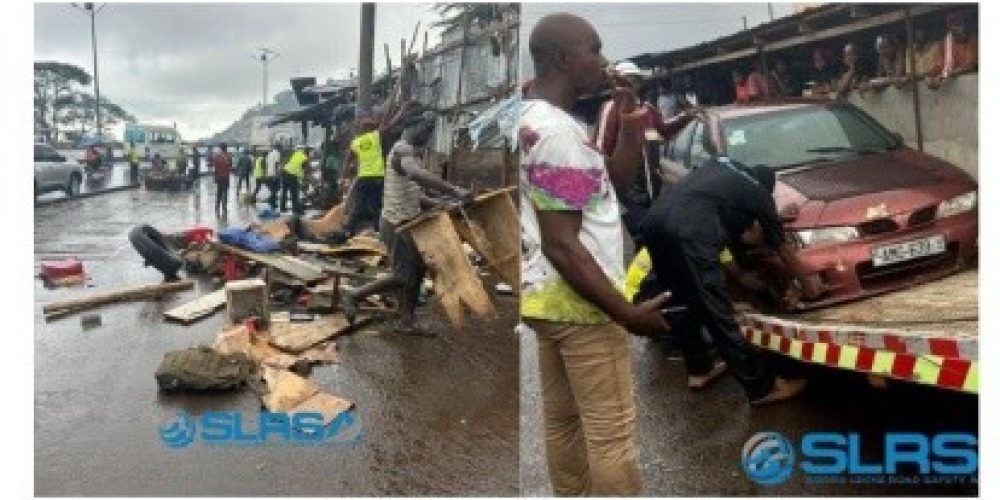
The Sierra Leone Roads Safety Authority (SLRSA) has launched a major enforcement operation to dismantle illegal garages and makeshift auto repair shops at Model Junction in Freetown, aiming to restore road safety and urban order at one of the city’s most congested intersections.
The crackdown, which began in earnest last week, follows months of public outcry and official warnings over the growing number of unauthorized automobile businesses encroaching on public roads, pedestrian walkways, and green spaces, the operation, carried out in collaboration with the Sierra Leone police, Freetown City Council, and the ministry of transport and aviation, signals a renewed push to reclaim public infrastructure from informal occupation.
Once a functional and relatively smooth roundabout linking several key roads in eastern Freetown, Model Junction has devolved into a traffic bottleneck, abandoned vehicles, haphazard repairs, and roadside vendors have turned the area into a daily hazard for drivers, commuters, and pedestrians.
The situation had become unsustainable, said Ibrahim Kargbo, director of operations at SLRSA, these illegal garages were not only violating zoning laws, but also posing serious safety risks. We have a duty to protect public space and lives.”
Kargbo added that the move is part of a broader urban reform effort to reduce traffic congestion, prevent accidents linked to poor vehicle maintenance, and restore order in public spaces, the clampdown has sparked backlash from some garage operators and spare part vendors, many of whom say they were not given adequate warning or viable alternatives.
We understand the need to clean up the city, but where do they expect us to go asked Mohamed Jalloh, a 28-year-old mechanic whose roadside garage was dismantled, this is how we feed our families, if they want us out, they should give us a proper place to operate legally, Fatmata Conteh, a spare parts seller, echoed the sentiment.
They can’t just chase us away, we’ve been here for years and some of us even pay local taxes, we deserve to be part of the solution, not the problem. In response, officials from the Ministry of Transport say plans are underway to establish a designated mechanic village on the outskirts of Freetown, where mechanics and vendors will be registered and provided with proper facilities. However, a timeline for implementation has yet to be confirmed.
We are not against business, but we are against disorder, said Hon. Paul Senessie, deputy minister of transport and aviation, this is about balancing entrepreneurship with public safety and sustainable planning.
Among residents and commuters, the move has generated mixed reactions. Some praise the cleanup, describing the former state of Model Junction as chaotic and dangerous. I used to dread passing through here, said Rebecca Kamara, a university student. It was like an obstacle course engines, parts, and people everywhere. Now it feels like there’s finally some order.”
Others, however, remain doubtful about the longevity of the effort, we’ve seen these kinds of cleanups before, said Ishmail Dumbuya, a taxi driver. They clear the area today, and next week the garages are back. If there’s no lasting plan, this is just for show.
The situation at Model Junction has reignited calls for comprehensive urban planning and better enforcement of land use policies. Experts argue that decades of unregulated development, population growth, and institutional inaction have enabled the informal sector to sprawl into critical public spaces.
The issue is structural, said Madam Isata Koroma, an urban development lecturer at Fourah Bay College. You can’t build a sustainable city without planning for the informal economy. Banning businesses without offering alternatives only shifts the problem elsewhere.
SLRSA officials maintain that the Model Junction operation is just the beginning. The agency has reportedly begun mapping other hotspots across the city where unauthorized garages and vendors have occupied roads and drainage systems, as Freetown wrestles with the dual challenge of economic survival and urban order, officials, experts, and citizens agree on one thing: sustainable solutions must be inclusive.
This cannot be a war between government and informal workers, said Mayor Yvonne Aki-Sawyerr in a brief statement. We need a middle ground one that supports entrepreneurship while protecting public infrastructure. That means designated zones, proper licensing, and public education. Back at Model Junction, the sidewalks are beginning to clear. While a few defiant vendors remain, warily watching enforcement officers, the message is clear: change is underway. Whether that change is inclusive, permanent, and replicable across the city remains to be seen.
Copy right –Printed in the Expo Times News on Friday, June 13TH, 2025 (ExpoTimes News – Expo Media Group (expomediasl.com)