



By Kadiatu A. Turay
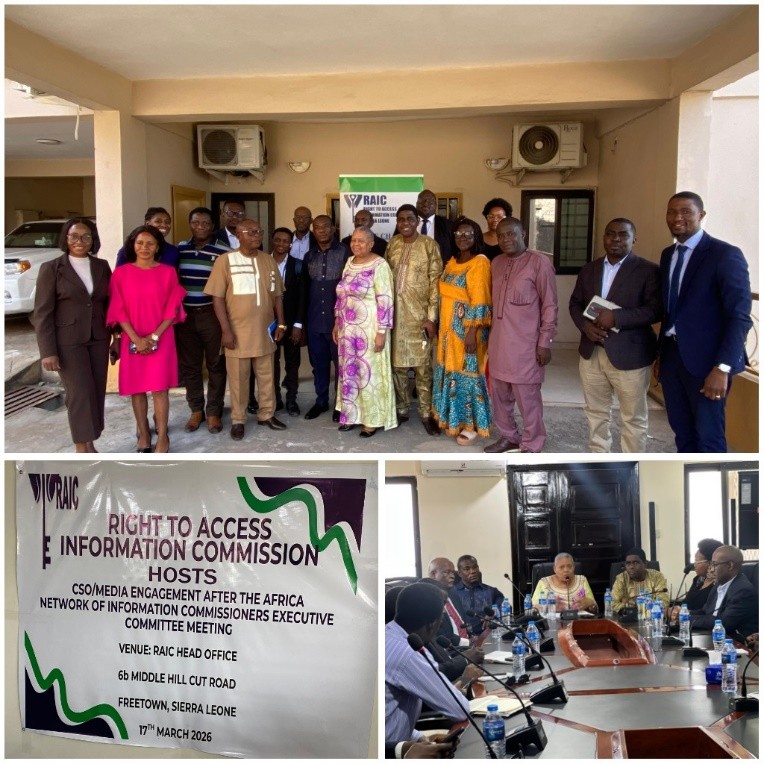
Sierra Leone has once again positioned itself at the forefront of transparency and accountability in Africa as the Right to Access Information Commission (RAIC) hosted a high-level Civil Society Organization (CSO) and media engagement in Freetown on March 18th 2026. The event, which took place at the RAIC head office at 6b Middle Hill Cut Road in Freetown followed the African Network of Information Commissioners (ANIC) Executive Committee Meeting at the same venue, bringing together key stakeholders from across the continent to deepen conversations around access to information (ATI), governance, and citizen participation, as well support planning to host the ICIC-IDUAI conference in Sierra Loene in September this year.
The engagement served not only as a platform for dialogue but also as a reaffirmation of the country’s commitment to strengthening democratic institutions through openness and public accountability.
In his keynote submission, RAIC Chairman, Dr. Ibrahim Seaga Shaw, highlighted Sierra Leone’s journey within the global access to information movement, stressing that the Commission’s work is anchored in international collaboration.
“We are not operating in a vacuum, in isolation. We are part of the global community of information commissioners,” Dr. Shaw stated.
He recalled that Sierra Leone officially joined the International Conference of Information Commissioners (ICIC) on September 24, 2019, and has since actively contributed to global and continental discussions on transparency. According to him, it was during one such international engagement that the idea for the African Network of Information Commissioners (ANIC) was conceived.
“That meeting was more like the founding moment of ANIC… we met and agreed that we come up with the idea,” he explained.
Dr. Shaw further noted that Sierra Leone currently holds a seat on the ANIC Executive Board, reflecting its growing influence in shaping access to information policies across Africa.
“We have been very active not just in Sierra Leone, but also in the international space,” he said. “We are trying to push the boundaries of access to information because we know we cannot achieve it alone.”
He emphasized that collaboration among African countries has enabled the sharing of best practices, with Sierra Leone both learning from and contributing to experiences from countries such as Ghana and South Africa.
“A lot of the things that you see we do here… we have been able to learn from other countries, and they have also been able to learn from us,” he noted.
While celebrating progress, Dr. Shaw acknowledged that challenges remain, particularly in ensuring compliance by public institutions. He issued a firm warning to institutions that fail to respond to information requests within the stipulated timeframe.
“By not responding, you are already in default,” he said. “Even if you want to rely on exemptions, you must engage the requester and explain why.”
He also pointed to structural and resource constraints within the Commission, revealing the extent of capacity limitations.
“Can you imagine the whole legal and compliance department has only one lawyer? Just one lawyer… We want to do a lot, but we are constrained,” he lamented, calling for increased support as the Commission’s mandate expands under proposed legal reforms.
Dr. Shaw also underscored the critical role played by civil society and the media in the passage of the ATI law, which followed nearly a decade of sustained advocacy.
“Civil society actors were very instrumental in bringing about this law… and the media also played an active role,” he said.
He disclosed that RAIC has recently taken steps to revive the Civil Society Coalition to strengthen partnerships and broaden participation.
“We called for a meeting, and it was very successful. But we are hoping that more will join,” he added.
Delivering a compelling continental perspective, Advocate Pansy Tlakula, Chairperson of the Information Regulator of South Africa and Chairperson of ANIC, stressed that access to information is foundational to the functioning of any democracy.
“Access to information is one of the most important rights in any constitutional democracy. Without access to information, all other rights are vulnerable,” she said.
She explained that citizens cannot effectively exercise their rights whether voting, accessing education, or protecting their environment without access to accurate and timely information.
“If you don’t have information, how do you exercise your right to vote? You can’t,” she remarked.
Advocate Tlakula emphasized that laws alone are insufficient unless citizens actively use them to demand accountability.
“That law can never change people’s lives if no one uses it to hold the government to account,” she said. “The information that they hold is not theirs… it belongs to us as people.”
She highlighted that ANIC was established to foster cooperation, shared learning, and mutual support among African countries navigating the complexities of enforcing ATI laws.
“The main objective of ANIC is to share experiences, to share best practices… and to support each other,” she said.
She also acknowledged the challenges faced by information regulators, noting that the work often involves confronting powerful institutions.
“You have to hold those who have power to account. You have to speak truth to power,” she emphasized.
From Ghana, Stephen Owusu, Esq., General Manager for Legal, Governance, Regulatory and Research at the Right to Information Commission, reinforced the importance of enforcement and compliance.
“Information is key, especially for transparency and accountability. The absence of accurate information leads to assumptions and these assumptions might lead to something catastrophic,” he warned.
He made it clear that institutions must be held accountable under the law if they fail to respond to requests.
“If we don’t get the information, we are going to use the law. Nothing is going to stop us,” he asserted.
Civil society participants used the platform to express concerns about ongoing barriers to accessing information, including selective disclosure by public authorities.
“Only information that authorities are comfortable to release is what they give out,” one advocate observed, highlighting the need for stronger enforcement mechanisms.
A notable issue raised during the engagement was the failure of Parliament to respond to information requests submitted by civil society organizations and citizens seeking basic contact details about Members of Parliament. Despite the expiration of the legally mandated response period, no feedback has been received, prompting escalation to the Commission.
Participants stressed that such instances underscore the gap between the existence of the law and its practical implementation.
Discussions also explored the evolving nature of access to information, particularly the need to extend obligations beyond public institutions to private entities engaged in public business. Dr. Shaw explained that under Sierra Leone’s legal framework, the definition of a public authority is broad.
Entities that receive public funds or provide services on behalf of the government are subject to ATI requirements, a move seen as critical in promoting transparency in public procurement and service delivery.
The intersection between access to information and data protection also featured prominently in the dialogue, with stakeholders pointing to emerging reforms that would integrate both frameworks under a single authority similar to the South African model.
As Sierra Leone prepares to host the global ICIC conference later this year, stakeholders say the country has a unique opportunity to demonstrate leadership in advancing transparency and democratic governance.
The engagement concluded with a renewed call for collective action, with government institutions, civil society and media all urged to play their part in ensuring that access to information laws move beyond paper commitments to tangible improvements in people’s lives.
For many participants, the message was clear: access to information is not just a legal right it is a powerful tool for empowerment, accountability, and national development.
Copyright –Published in Expo Times News on Monday, 23rd March 2026 (ExpoTimes News – Expo Media Group (expomediasl.com)