



By Amara Thoronka
The influential role of the media mind construction and mind deconstruction or in creating imagery or psychological realities is something so evident in human development, transactions and engagements in all walks of like. The print, electronic media and how they have been converged by the internet make is largely realistically impossible for anyone consistently exposed to them (media) not to be influenced by their contents.
Children are a set of people that can be easily influenced by the media, especially in their consumption of visual contents; that is, photos, videos and audio-visuals.
Childhood, Poverty and desire for films
I grew up at Jalloh Terrace, a large, populated community in east Freetown, the capital of the West African state of Sierra Leone. The movie ‘Issakaba’ was released around 2001 at a time when most of the houses in the Jalloh Terrace community [mine inclusive] were without television. I was in my early stage at primary/elementary school.
Children who wanted to watch films would have to go to the privileged few, behaved themselves and watch films from Nollywood [Nigerian film industry], Bollywood [Indian film industry] Hollywood [United States film industry] and Ghallywood [Ghanaian film industry] and those form the Chinese film industry.
Sometimes, we are carried away by the appealing scenes of some movies which would cause us to be late to return to our respective homes. Such lateness could warrant knocks on the head and/or lashes on the buttocks as a form of punishment for staying away from home at a time we should be studying or be in bed. The few families who had television were highly respected. We sometimes helped them draw water from the well as a way of having undenied access to their homes to watch more movies.
The plot of Issakaba
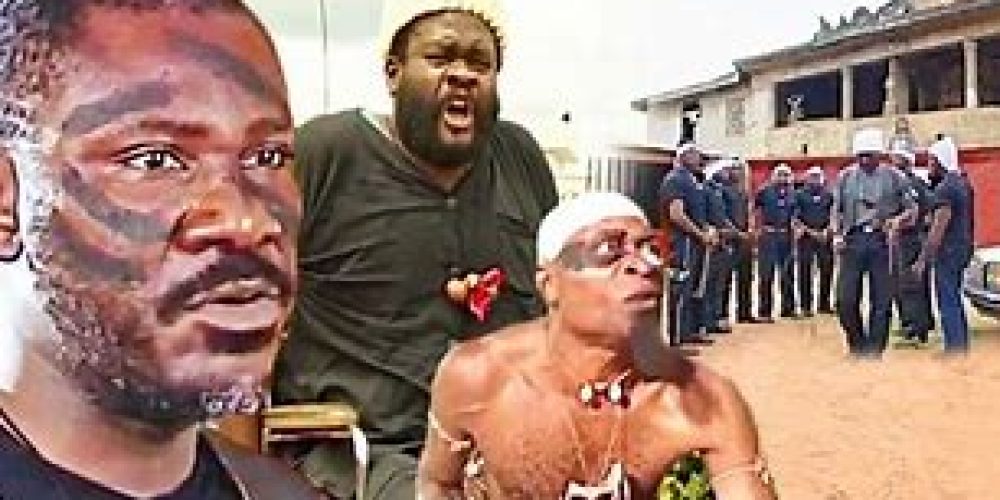
To date, many adult Africans are of the assertion that the Nollywood movie, Issakaba, is the greatest African action movie ever. It is a 2001 Nigerian film in which a secret society turned vigilante boys called “Issakabba Boys” use charms and cutlasses to fight against serious crimes such as armed robbery, murder, ritual killing and more.
The justice-driven Issakabba boys are led by the protagonist (main actor) of the movie, Ebube (Sam Dede). They are dressed in black and red with cutlasses in their hands and charms on their bodies. The kingdom is overwhelmed with crime and evil everywhere. Armed robbers have a superpower that is given to them by evil traditional medicine men. The robbers are also being protected by some corrupt elders and security personnel occupying influential positions in the kingdom.
Amidst challenges, the Issakaba were able to bring to book all armed robbers, corrupt police officers, crooked elders and evil medicine men. Issakaba punishes evil and crime doers by either chopping off their limbs or heads or burning them alive.
Impact on childhood
I was eight years old when the movie was released. After a few weeks of watching Issakaba, I and other male children started using the actions in the movie in our interactions and fun games. Some could take the role of Issakaba boys while others acted as the armed robbers, native medicine men, elders, police and other villagers.
Instead of using cutlasses like the Issakaba boys, we instead used dry okra sticks and other light objects to punish the wrongdoers. We used palm oil or any red-coloured liquid to symbolize the blood of an amputated criminal.
In the absence of black clothes used by Issakaba, we tied a small piece of black cloth on our wrists and heads. When the hand or head of a criminal was to be cut off, the leader of our own Issakaba play would shout “Eeeeee” and the rest would say “Sakabaaaaaa.”
The Issakaba play influenced our play style for years. We put so much effort, time and energy to imitate characters, actions and even sounds in the Issakaba film. Even when we were often warmed and beaten to stop such a play, we were adamant and resistant. The play was everywhere. People talked about the movie in schools, offices, marketplaces, homes, social gatherings, public transport – everywhere.
We could watch the film twice a week but would still want to watch it the following week. Personally, at around 10 years old, I had a small notebook for proverbs, idioms and other unique expressions used in the play.
The ones I will never forget are: “The river does not flow throw down the forest without bringing down trees,” “The child who says the mother will not sleep, he too will not sleep,” “The smoke and the rabbit have never been friends,” “Your evil deeds have come to light so this is the end of the road,” “When the fire dies the ashes remain to bear testimony of the flames,” and “When the birds become too big for its cage you let it go.” The proverbs and wise sayings in the movie are just too many to highlight wholly.
The film preoccupied the leisure moments of kids both on-screen and in their playing. Recently, I learnt that, because of the excellent and impactful nature of the movie, and for the sake of popular demand, the return of the movie is being worked on and may soon be out.
To parents and other adults
The media, especially televised contents, have an indelible and influential impact on people. Television and other visual media are far much powerful in influencing the attitude and behaviour of kids than any mass medium. TV is audiovisual, a blend of video and audio. Its contents are graphic and captivating.
Parents and all adults should endeavour to guide the TV contents which their children are exposed to. Children should not be exposed to films or TV/video programmes with sexual, gory and violent scenes. Cartoons and teaching videos can help children to be smart, bold and friendly; while violent, drug-addicted and sexual TV contents may influence children to engage in antisocial activities and early sex.
Schools should also embrace visual teaching aides to enable pupils to have lasting imagery of concepts, practices, techniques and principles.
Copyright –Published in Expo Times News on Wednesday, February 14th, 2024 (ExpoTimes News – Expo Media Group (expomediasl.com)