



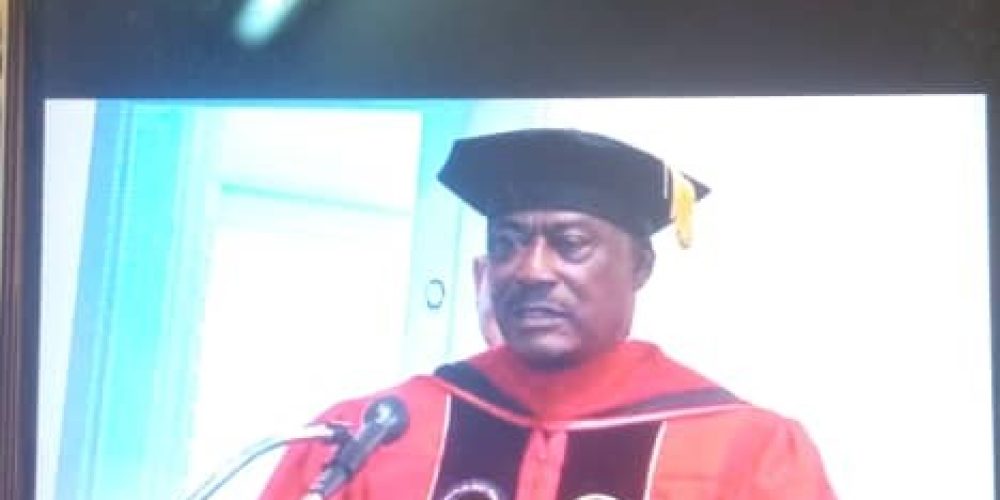
By Rev. Dr. Paul Bala Samura
Education is the primary factor in a nation’s development. Schools have debated the topic, “Education is Better Than Money.” Those who supported or defended the motion almost always win. Those who oppose the motion often argue that money is the instrument for acquiring education, with which I agree to some extent. However, according to a study by the University of Toronto, people with a degree are likelier to be happy than those without a degree. Education is more likely to be worth the investment because it decreases the likelihood of unemployment, poverty, and crime and for high-paying jobs. Furthermore, education is better than Money because Money can’t buy happiness; people with a higher education are more likely to find jobs that match their skills, and a college degree is more likely to lead to a successful career.
While researching this article, I stumbled upon some fascinating educational statistics that will enlighten and inform my readers.
- The Top 5 most educated African Tribes are – 1) Tutsi of Central Africa, 2) Venda of South Africa, 3) Lebou of Senegal, 4) Gurage of Ethiopia, and 5) Igbo of Nigeria.
- The Top 10 most educated countries or with the highest literacy rate: 1) South Korea -97.9%, 2) Canada – 66.36%, 3) Japan -65%, 4) Luxemburg – 63.12%, 5) Ireland -62.88%, 6) U.K. – 57.47%, 7) Lithuania – 57.47%, 8) Netherland – 55.60%, 9) Norway -55.03%, and 10) Australia – 54%.
- Chinecherem Nduka (May 30, 2024) listed the Top 10 most educated countries in Africa: – 1) Seychelles -69.3 Points, 2) Tunisia – 61.4 Points, 3) Mauritius – 61 Points, 4) South Africa – 58.4 Points, 5) Algeria – 57.4 Points, 6) Botswana – 56.7 points, 7) Kenya – 55.3 Points, 8) Cape Verde – 53.3 points, 9) Egypt – 53.3Points, and 10) Namibia – 52.7 Points.
- Folatanmi Ajayi (April 19, 2023) listed the ten lowest-ranked African countries in education as follows: 1) Niger, 2) Burkina Faso, 3) Mali, 4) Central African Republic, 5) Ethiopia, 6) Eritrea, 7) Guinea, 8) Zambia, 9) Gambia, 10) Angola.
Do you want to know Sierra Leone’s literacy rate? Remember, since 2018, the country promoted Free and Quality Education. Do you expect us to be high or low in education? Well, that is not the scope of this article. This article will discuss how to improve education in Sierra Leone for nation-building.
Improving education requires a multi-faceted approach addressing various aspects of the educational system. Here are some effective strategies to enhance the quality of teaching and learning in Sierra Leone:
- The government should enhance Teacher Training and Professional Development. I suggest:
- Continuous teacher training to effect this change in education.
The Ministry of Basic Education should provide regular professional development opportunities to help teachers stay updated with the latest teaching methodologies, technologies, and subject knowledge. When was the last time the Ministry provided refresher training for teachers? The Ministry should require every teacher to undergo refresher training every three years because the world is so dynamic that new inventions occur every three years.
- b) The government should create mentorship Programmes for teachers. I just completed a doctorate in Developing a Mentoring Model for Training for Leaders. Throughout my three years of study, I unravelled the significance of mentoring children, youth, students, and workers. First, after a year of observation, I noticed that mentorship was lacking. Therefore, I chose a context to work with, identified the problem, framed a title and a hypothesis, and set to research. The Ministry of Basic Education should establish mentorship programs where experienced teachers guide and support new or struggling teachers.
- All schools require effective Classroom Management.
For my bachelor’s degree, I read Christian Education and did my teaching practice in Nigeria. Having taught in Sierra Leone in primary and secondary schools before finishing my degree in Nigeria, I gained a different perspective on classroom management. If not for the fear that my readers would “But Sierra Leone is not America,” I would have also included classroom management in the U.S. I would say here that the Ministry should offer training in classroom management techniques to create a conducive learning environment. Most classrooms are overcrowded and untidy.
2). The Ministry of Basic Education should integrate Technology into Education. Technology plays a crucial role in today’s teaching and learning. The sad reality of my country is that we boast of technology only through cell phones. In 2018, I was present in a student/staff assembly at a university where I laughed over a disagreement between the principal and his V.P. The principal said, “From now on, students will apply online,” but the V.P. quickly responded in defense of the students, “But Mr. Principal, not now but later.” I almost laughed out of my bowels because I was on holiday from the U.S., where 50% of the program is online, including applications (which I did from Sierra Leone), syllabi, grades, and announcements). In the U.S., parents or guardians must apply online for their children. There is no ‘NO PAPER’ Work for schools.
Another thing I noticed about the education system in the U.S. or the West is that there’s NOTHING LIKE OPENING A PORTAL FOR APPLICATION. However, each school, college, or university has deadlines for different programs, and one can apply today for a January 2025 or May 2025 deadline. The admission counselor receives notification of all applications and provides guardians throughout the process.
a). The government should provide digital resources to all schools, such as utilizing digital tools and resources to enhance learning, including interactive whiteboards, educational software, and online resources.
- b) There should E-Learning Platforms: Implement e-learning platforms that allow for personalized learning experiences, enabling students to learn at their own pace.
c). Internet Access: Ensure all students can access the internet and digital devices, bridging the digital divide. Is there a university where every student has a laptop and access to uninterrupted internet and electricity? The trending news is that students, especially female students, can afford the iPhone 15 Pro-max at $1,069, personally or gifted, but cannot buy a laptop for $300.
- The Ministry should improve the Curriculum and Instruction.
Having studied in Sierra Leone, Nigeria, the Philippines, and the U.S., the education system in Africa follows the traditional lecture-based teaching method. This method focuses more on exams. That’s why in Sierra Leone, colleges and universities use semester or yearly exams to promote students. For example, at Milton Margai, the Diploma is 25% Continuous Assessment, HTC is 30%, and 40% for the degree. These percentages are CASS and thresholds. The remaining 75%, 70%, and 60% come from the semester exams. A student who scores below 70% in the U.S. school system repeats the course. A graduate student must score 80% for each course or repeat. American education curricula are more practical than African curricula.
The Sierra Leone curriculum must be Student-Centered Learning: Shift from traditional lecture-based teaching to student-centered learning approaches that encourage active participation and critical thinking. Teachers should assign projects to students in each class or as assignments. I usually wonder how city teachers teach agriculture without farms or school gardens. When I was in secondary school in Kamakwie, the school had a farm where students planted crops. How many schools in rural areas have school gardens?
The introduction of STEAM Education: Integrate Science, Technology, Engineering, Arts, and Mathematics (STEAM) into the curriculum to foster creativity and innovation. How many schools have functional laboratories? In the 2024 WASSCE English Essay paper, WAEC asked five questions to answer one. Here is Question 4: Your school does not have functional laboratories. Please write a letter to the Parent-Teacher Association Chairman pointing out at least three effects of this lack on the students and pleading with him to provide some for the school. In my opinion, this is the most practical question, and if students answer it correctly, it may help or guide school heads in addressing the issue. I also wish that principals would organize a symposium where students would have the opportunity to discuss the lack of functional laboratories in their schools.
School administration should teach more practical applications, including project-based and experiential learning opportunities that connect classroom lessons to real-world applications. Applying classroom learning to real-world life situations is the core of education.
I mentored graduate students from Nigeria, Ghana, Zambia, Lebanon, the USA, India, and Kenya throughout my doctoral studies. I also spent six weeks training leaders on mentoring. I made the title practical and replicated each paper I wrote.
If the government improves education, the nation will develop.
TO BE CONTINUED…
Copyright –Published in print in Expo Times Newspaper on Monday, June 7th , 2024 (ExpoTimes News – Expo Media Group (expomediasl.com)