



by Chernor M. Jalloh
“The health of a democracy depends on the degree to which its citizens understand and uphold its institutions.” — Alexis de Tocqueville
I have lived long enough in Sierra Leone to recognise when the national mood begins to shift. You sense it in the taxis weaving through Freetown’s restless morning traffic, in the animated arguments at poda-poda stations, and in the uneasy silences of living rooms where families whisper their political anxieties. But it is in the digital public square — among online commentators, self-styled analysts, and partisan columnists — that the sharpest distortions of political reality now take root.
It was in this noisy arena that I recently came across a headline in The Organiser News (02/12/2025), written by journalist Abu Shaw, branding President Julius Maada Bio as a “comical and illegitimate president.” I paused, not out of outrage, but out of concern. In fragile democracies like ours, the word illegitimate carries a destructive elasticity. It can slip easily from critique into crisis, from political frustration into an invitation for disorder. I recalled times in my youth when Sierra Leone stood perilously close to the edge. Words mattered then; they matter even more now. And so I felt compelled to respond — not merely to defend a president, but to defend the meaning of legitimacy itself.
Where My Concern Began
My instinctive reaction was not political; it was constitutional. Having spent years teaching public policy and governance, I have come to regard legitimacy — not popularity, not perfection — as the bedrock of political authority. When the term is used casually, as if legitimacy were simply a matter of taste or sentiment, something fundamental is at stake.
Political theorists from Max Weber to contemporary governance scholars argue that legitimacy is not an emotional endorsement but a “procedural and institutional relationship.” It rests on three interdependent pillars: the integrity of the procedures that confer authority, the recognition granted by domestic and international actors, and the existence of corrective mechanisms to resolve disputes and strengthen the system.
If constitutional procedures are followed, if both national and international actors recognise the outcome, and if the system provides lawful avenues for contestation, then a leader is legitimate — even when many disagree with him. That is why wielding the word “illegitimate” as a rhetorical weapon is not only intellectually careless; it is politically dangerous.
The 2023 Elections: A Dispute, Not a Nullity
Let me state plainly: the 2023 elections were far from perfect. Observer missions from ECOWAS, the African Union, the Commonwealth, and domestic civil society raised concerns about transparency in the tabulation process. The opposition, the APC, contested the results vigorously — a right protected by democratic norms. But despite all the concerns, no observer mission declared the elections void, nor did any constitutional body invalidate the presidency. Instead, each report called for calm, dialogue, and systemic improvement.
And crucially, dialogue did happen. In the presence of ECOWAS, the AU, and the Commonwealth, the Government and the APC signed the October 2023 Agreement, which established the Tripartite Committee to conduct a comprehensive review of the electoral system. Over the past twenty years of my work as a lecturer, governance adviser, and mediator, I have rarely seen Sierra Leone’s political actors choose institutional negotiation over confrontation. Yet this time, they did — and that, to me, was a quiet but important victory for democratic maturity.
The Committee’s final report identified structural reforms, not political illegitimacy. It did not call for annulling the presidency. Even the aggrieved party accepted the institutional path rather than pursuing destabilising alternatives. So when a journalist proclaims the presidency “illegal,” I must ask: If those with the greatest grievance chose law over rupture, who benefits from manufacturing a narrative of illegitimacy?
A Personal Memory of Crisis as Warning
I have witnessed firsthand how dangerous narratives take hold. After the 1992 coup, and again during the political turbulence of 1997, rumours of illegitimacy spread like wildfire. They created a climate in which constitutional order seemed optional — even disposable. Those memories shape my caution today. Words once used recklessly can become tinder for chaos.
International Recognition: Where the Argument Collapses
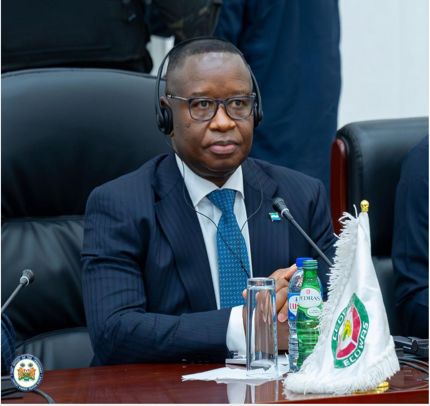
International recognition is where Abu Shaw’s claim collapses entirely. In June 2025, West African Heads of State unanimously elected President Bio as Chairman of ECOWAS, the region’s highest political office. In all my years working with regional institutions, I have never witnessed ECOWAS elevate a leader whose legitimacy it doubts. The very suggestion defies logic.
This same supposedly “comical” and “illegitimate” leader:
- Presided over the United Nations Security Council, guiding a debate on global governance reform;
- Addressed the G20 Summit in Johannesburg, presenting a substantive agenda on debt justice, climate financing, digital governance, and fair mineral value chains;
- Led ECOWAS mediation in Guinea-Bissau, during one of its most volatile constitutional moments.
These are not honours conferred upon impostors. They are credible, formal affirmations of sovereign leadership. I challenge any critic: Show me a world in which a leader deemed illegitimate is simultaneously entrusted to chair ECOWAS and address the G20. The contradiction collapses on contact with reality.
The APC’s Internal Contradictions: Owning the Political Mathematics
It has always puzzled me when commentators blame President Bio for the APC’s loss in 2023. Having followed Sierra Leonean politics closely, I know that internal unity is often the missing variable in the algebra of electoral success. The APC of 2023 was deeply divided. Senior executives did not uniformly rally behind Dr. Samura Kamara’s claims of victory; many quietly transitioned into preparing for 2028, aligning themselves with the settlement emerging from the post-election dialogue.
This is not an indictment of the APC — it remains an essential pillar of our democracy. But political parties must own their strategies. One cannot decline to fully pursue a disputed claim, then retroactively accuse the opponent of “stealing” the victory one did not vigorously defend. Politics is rarely theft; more often, it is strategy, coherence, and timing.
Why the “Comical President” Narrative Fails
Political frustration is understandable. But caricature is not analysis. President Bio’s speeches at the G20, ECOWAS, and UNSC were substantive engagements with Africa’s most pressing structural questions — from climate adaptation and energy transition to mineral value addition and debt restructuring. You may critique his domestic governance; that is legitimate. But dismissing a head of state who represents Sierra Leone on the world’s most consequential platforms as “comical” is intellectually unserious. As I often tell my students: critique without evidence is not critique — it is noise.
A More Honest National Conversation
Sierra Leone needs bold journalism. But it must be grounded in fact, not fury. We need commentators who ask tough, essential questions:
- Has ECSL begun implementing the Tripartite reforms?
- Are political parties democratizing internally?
- Are institutions becoming stronger or weaker?
- Is corruption being meaningfully addressed?
But what we do not need is the reckless elevation of electoral dispute into wholesale delegitimation.
The consequences are visible across West Africa:
- Guinea (2021): allegations of illegitimacy helped rationalise a coup;
- Burkina Faso (2022): perceptions of “lost legitimacy” justified the military dissolving the state;
- Guinea-Bissau: where mistrust continually mutates into instability.
Do we truly wish to rehearse those tragedies here?
My Final Reflection
I do not write this to venerate President Bio. No leader is exempt from scrutiny. Democracy thrives only when leaders feel the weight of accountability. Yet democracy also requires fairness, precision, and responsibility — particularly from those who shape public opinion.
Sierra Leone is not suffering from a crisis of presidential illegitimacy. It is suffering from fragile institutions, eroding trust, and elite impatience. These can be fixed. What cannot be easily repaired is a fractured national narrative — one damaged by reckless claims that undermine the constitutional framework that holds our Republic together.
So I end with this appeal: let us argue vigorously, debate passionately, and criticise where necessary — but let us not manufacture illegitimacy where the Constitution, the region, and the international community clearly recognise lawful authority. President Julius Maada Bio may be contested and imperfect, but he is not illegitimate. He is the constitutionally sworn-in, regionally affirmed, and internationally engaged President of Sierra Leone — and the current Chair of ECOWAS. These are not partisan slogans but stubborn facts that endure beyond the noise of political quarrels. Legitimacy is not a favour granted out of affection; it is the constitutional order we uphold out of national necessity.
Copyright –Published in Expo Times News on Wednesday, 10th December 2025 (ExpoTimes News – Expo Media Group (expomediasl.com)