



By Amara Thoronka
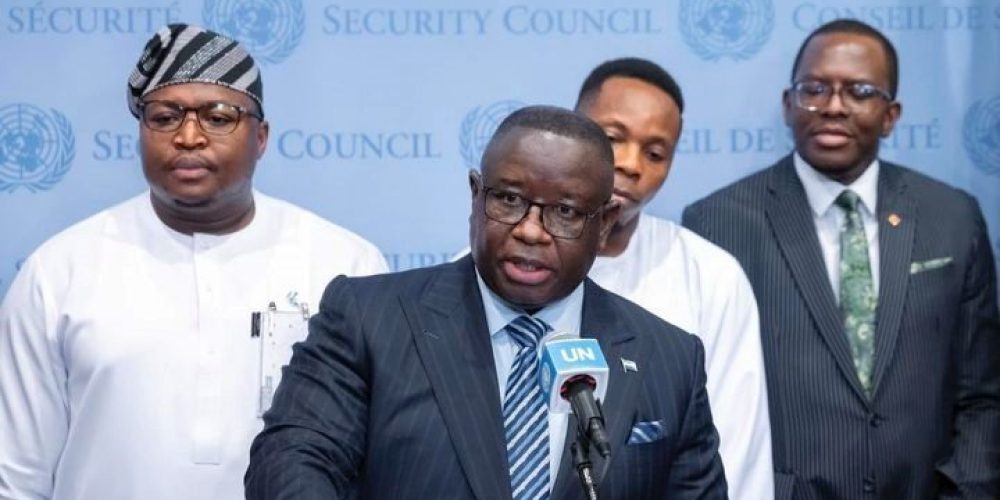
President Bio speaking at UNSC
His Excellency Brigadier (Rtd) Julius Maada Bio, President of Sierra Leone has made a strong case for the African continent at the United Nations Security Council on Monday, 12th August, 2023 in New York City, United States of America. Following the assumption of Sierra Leone to the presidency of the UN Security Council for the month of August, President Bio presided over a United Nations Security Council debate on the motion: “Maintenance of International Peace and Security: Addressing the Historical Injustice and Enhancing Africa’s Effective Representation in The UN Security Council”.
Speaking in his capacity as President of Sierra Leone and Chairman of the African Union Committee of Ten Heads of State and Government on UN Security Council Reform (C-10), President Julius Maada Bio said Africa has long been under-represented in the decision-making processes on global peace and security, while emphasizing the need for reforming the UN Security Council.
The UN Security Council has 15 members: five permanent members with veto power [United States, United Kingdom, Russia, China and France] and ten non-permanent members elected for a two-year term. The whole of Africa has never had a permanent membership of the global security body since its establishment about 80 years now.
It is against this backdrop President Bio noted that, “Its imbalanced composition is at odds with current realities and unjust, undermining its legitimacy and effectiveness. Africa remains the unquestionable victim. With the absence of structural change, the Security Council’s performance and legitimacy remain questionable. It is essential to recognise how the historical injustice has significantly hindered Africa’s ability to contribute effectively to global governance. The legacy of colonialism, economic exploitation, and political marginalisation has left deep scars on the Continent, affecting its development, stability, and influence in international affairs.”
The President of Sierra Leone recollected that the Security Council was founded on principles of equality, justice, and the collective pursuit of peace, but that the current structure of the Security Council reflects what he calls “an outdated world order, an era that fails to recognise Africa’s growing importance and contributions.”
“Despite being home to over 1.3 billion people, and the 54 African countries making up 28 per cent of the total membership of the UN, with significant contributions to peacekeeping and conflict resolution, Africa remains grossly underrepresented in this vital organ of the UN. This underrepresentation is not merely an anomaly of statistics; it is a profound historical injustice that must be addressed,” he explained.
The President of Sierra Leone who doubles as Chairman of the African Union C-10, submitted that Africa demands two permanent seats in the UN Security Council and two additional non-permanent seats, bringing the total number of non-permanent seats to five.
On which African nations are to represent the continent at the permanent member category of the UN Security Council, President Bio informed that, “The African Union will choose the African Permanent Members.”
He further informed members of the Security Council and the wider UN membership and leadership that Africa wants the veto of permanent members abolished, but was quick to note that, if UN member states wish to retain the veto, it must be extended to all new permanent members as a matter of justice.
President Bio mentioned that Africa’s experiences and perspectives remain invaluable in shaping comprehensive and effective solutions to global challenges, and that the continent having two permanent and two non-permanent seats at the UN Security Council would further unlock Africa’s full potential as a dynamic and vibrant continent capable of meaningfully contributing to the advancement of peace, security, and stability worldwide.
Emphasizing on the perennial challenges of the continent at the peace and security architecture, the President cited continued scars and implications of slavery and colonization on Africa. “This historical injustice stems from colonial legacies and power imbalances that persist to this day. The legacy of slavery intersects with other forms of historical injustice, including colonialism, imperialism, and exploitation. Therefore, the current architecture of international institutions, including the UN Security Council, as noted, reflects the geopolitical realities of the post-World War II era, which largely excluded African voices. This paradigm of non-representation and/or underrepresentation means that Africa’s perspectives and priorities are regrettably overlooked in global decision making processes,” President Bio narrated.
He continued that the absence of permanent African representation in the Security Council means that decisions impacting the continent are made without sufficient African input, leading to policies that may not align with the needs and aspirations of African nations. “It is absurd for the UN to enter into its eighth decade of existence with this scar of injustice against Africa. The UN cannot continue to swim against the tides of justice. The African Union’s admission to the G20 remains a welcome development that leads the way. Resolutely, this is where the call for treating Africa as a special case and priority in the UN Security Council reform process is fully strengthened,” he expressed.
He added that the time for the change Africa has been yearning for is now. “The call for enhanced African representation in global governance structures, especially the UN Security Council, is not just a demand for justice and equity. It is a call for a more inclusive, effective, and legitimate international governance system. Let us work together to redress this historical injustice and re-create a Security Council that truly represents the world in all its diversity,” he encouraged.
President Bio told global leaders that the time for what he called ‘half-measures and incremental progress’ is over, adding that Africa’s voice must be heard, and that its demands for justice and equity must be met.
He concluded by emphasizing that, in rectifying the historical injustice that has long plagued the continent, the UN has an opportunity to forge a more just and inclusive world order, one that honours the dignity and aspirations of all nations, regardless of their size or stature.