



By Amara Thoronka
Justice Edward Amoako Asante, the President of the Economic Community for West African States (ECOWAS) Court of Justice, has told member states that the community court is not in competition with their national courts, thus, the court seeks cordial relationship with courts of member states in the dispensation of justice within the subregion.
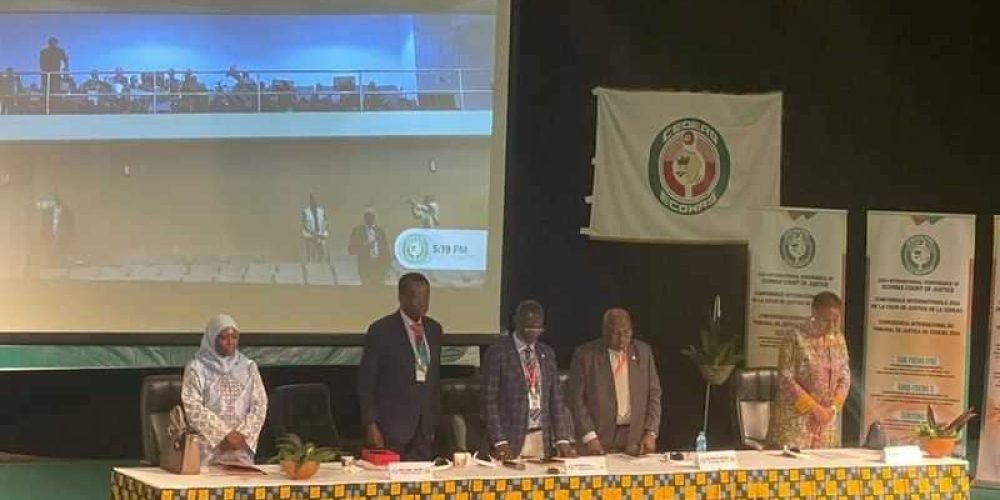
Justice Asante was speaking on Thursday, 16th May, 2024, at the closing of this year’s international conference organized by the ECOWAS Court in Freetown on the theme; “Enhancing the Role, Relevance and Effectiveness of the ECOWAS Court of Justice through the Strengthening of Synergies between the Court and National Stakeholders”.
“The ECOWAS Court of Justice has repeatedly emphasized that it is not in competition with national courts of member states. We are a court established by treaty and our mandate is clearly prescribed by the protocol of the court.
As an institution, we have a duty to maintain both synergies between the court and national courts and therefore seek a cordial harmonious relationship with national courts. We will continue to deepen fraternal relations between the court and national courts,” the President of ECOWAS Court explained.
He said they [the ECOWAS Court] are delighted for the success of the conference, saying, “the purpose has been achieved.”
Justice Asante expressed deep gratitude and appreciation to the President and People of Sierra Leone for the reception and hospitality accorded them throughout the conference.
“We express thanks and appreciation to the President of Sierra Leone His Excellency Dr. Julius Maada Bio to physically participate in this conference.
We have indeed been overwhelmed by the goodwill and very positive reviews the ECOWAS Court of Justice has received from participants at this conference. You have shown that the ECOWAS Court of Justice is playing a vital role in the region and that the importance of this human right mechanism cannot be overemphasized,” he noted.
On the flipside, the ECOWAS Court’s President expressed worrying concerns over the efforts of certain quarters in the subregion to prioritize the exhaustion of local remedies before going to the ECOWAS Court, saying such move poses a threat to the existence and mandate of the community court.
“It is therefore very disheartening that efforts are being made in some context to amend the protocol of the court to introduce the rule of exhaustion of local remedies. That is an attempt to renegotiate the mandate of the court and it is posing a great existential threat to the court. If this succeeds, it would drastically reduce access to the ECOWAS Court of Justice. This will weaken the court and it is definitely not in the best interest of the community and the court and should therefore be resisted,” he expressed.
He continued that they are glad that the just concluded international conference in Sierra Leone’s capital rejected such idea of adequately exhausting local remedies before seeking justice at the community court. “We are therefore appealing to all participants, civil society and all member states to take steps through advocacy with relevant stakeholders to ensure that the proposed amendment which is very imminent does not pass,” he encouraged.
Justice Asante called on member states to take necessary steps to domesticate the ECOWAS revised treaty, the ECOWAS protocols and to enact enabling laws that would enable national courts to play a more effective role in the litigation process. “The time has also come for the relevant stakeholders to take step to harmonize the legal and judicial process. There is therefore an urgent need for collaboration of the CECOWAS Court and national courts,” he said.
Making a statement, Chief Justice Nicholas Browne-Marke, the Acting Chief Justice of Sierra Leone, appreciated the efforts of the leadership of the community court in letting people understand its laws and practices.
“There has been enlightening and they have also enriched our knowledge of what the ECOWAS Court is about. You have exposed the ECOWAS Court to a lot of people who only read about it in newspapers. Most of the times, we hear about political decisions of ECOWAS Court, but seldom do we hear about what the court is doing, that is we Sierra Leoneans as a whole, not just us lawyers. So, this was a very good opportunity and we are thankful for you bringing this conference to our country,” Justice Browne-Marke narrated.
The Chief Justice of the Republic of Sierra Leone said he is pleased that the court found it possible to provide training for members of the Sierra Leone bar. He however noted the need for local legal representation in cases before the ECOWAS Court, because according to Justice Browne-Marke, many of the cases before the community court are being represented by Nigerian lawyers.
He stated that they [the Judiciary of Sierra Leone and the Bar of Sierra Leone] have learnt a lot from the conference, expressing hope that, in due course, more heed would be paid to the decision of the ECOWAS Court of Justice by member states.
Impressive cultural performance and presentation of awards and look books climaxed the four-day international conference.
Copyright –Published in print in Expo Times Newspaper on Friday, May 20TH, 2024 (ExpoTimes News – Expo Media Group (expomediasl.com)