







By Chernor Mohamadu Jalloh
In the heart of Freetown, the struggle for clean drinking water supply access has become a defining narrative for urban dwellers. Among these communities, Juba Hill in the West end stands out as an example of the severe challenges due to irregular water supply devised by the Guma Valley Water Company. The city’s exponential growth and burgeoning population exacerbate the water supply crisis, overwhelming the capacity of the Guma Valley Water Company. In informal settlements, the topography compounds the issue, creating hurdles for residents striving to secure safe drinking water.
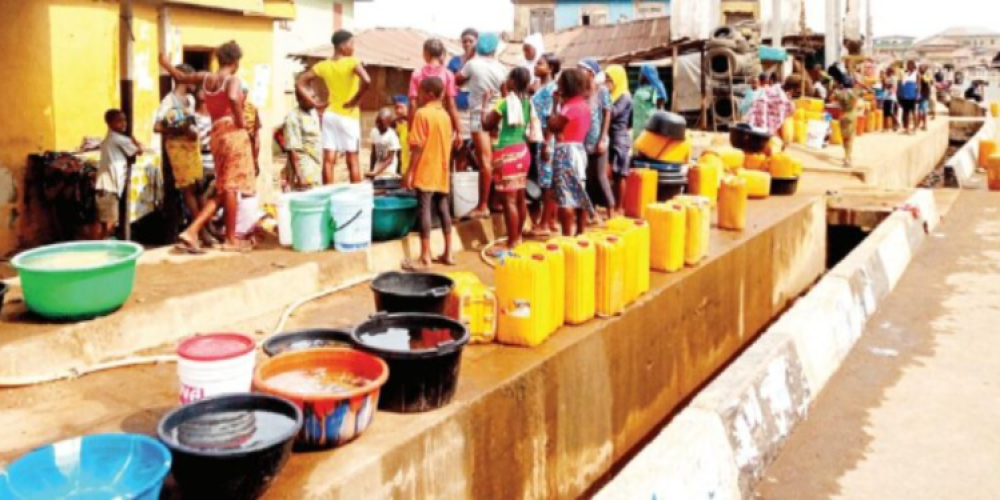
Nestled in Juba Hill, my current residence, the water scarcity issue unfolds vividly. Here, water pipes are poorly distributed, strictly rationed three times a week—on Tuesday afternoons, Thursday late nights, and Saturday afternoons. The meager water supply spans a mere 3 to 4 hours each time, compelling residents to endure extensive queues at scattered water hoses. Tensions escalate as disputes arise over priority and quantity, laying bare the disorganization perpetuated by the Guma Valley’s inefficient water management system. In fact, on Thursday late nights, the water barely reaches waist level, an impractical and unsustainable practice given that people are fast asleep when the pipes are opened. This irrational approach further exacerbates the challenges faced by the community.
The unequal distribution of water supply access is starkly evident even within the same street, as some households enjoy in-door piped borne water supply, while others rely on communal street taps. The absence of public facilities forces many to purchase water from neighbors, often from dubious sources, depending on the environmental conditions of the community.Challenges extend beyond Juba Hill, encompassing the entire city. The Guma Valley’s distribution system, marred by poor management, exacerbates the crisis and scarcity. While the west enjoys a relatively better water supply originating from safer sources, the quantity diminishes as it traverses to the east, leaving the far eastern ends virtually parched. But even the west is not immune to problems. Sections like Wilberforce and Hill Station face elevated terrain issues, requiring water to be pumped—a solution fraught with challenges like poor maintenance, technical issues, and electricity shortages.
Compounding the crisis is the financial strain on the country’s two urban water supply utilities, struggling to cover operation and maintenance costs. The lack of institutional capacity to collect tariffs, low billing rates, and high volumes of non-revenue water further contribute to the predicament. As a result, in the absence of sustainable cost recovery, Freetown’s reliance on development aid to finance water services is evident. This over-reliance not only hampers progress in increasing access but also perpetuates the deterioration of existing systems, leaving vulnerable communities at the mercy of formal and informal private water markets.
Despite the government’s commitment to cost recovery outlined in the National Water and Sanitation Policy, previous initiatives have yielded little success. The political economy surrounding urban water pricing, as observed in Freetown, remains a focal point of concern, with efforts to intervene by both government and donors falling short.
As Juba Hill grapples with a disorganized water supply and escalating tensions, it serves as a microcosm of Freetown’s larger water crisis. Urgent attention, both from authorities and the international community, is needed to address the root causes, ensuring a sustainable and equitable water supply for all. The time to act is now, as the thirst of a city cannot be quenched by rhetoric alone.
Copyright –Published in print in Expo Times Newspaper on Friday, December 15th, 2023 (ExpoTimes News – Expo Media Group (expomediasl.com)