




By Santigie Abu Kamara
Introduction
There would undoubtedly be security issues in a country with so many uncontrolled areas, open borders, and no restrictions on the entry of foreign nationals. This essay aims to address the risks that a security intelligence breakdown poses to Sierra Leone’s political and economic institutions.
Security Intelligence: In order to evaluate and strengthen a state’s security posture, security intelligence is the process of gathering, standardizing, and analyzing data that is produced in real-time by networks, applications. The field of security intelligence encompasses the utilization of both human resources and software assets to find practical and actionable insights that help the state reduce risk and mitigate threats to it citizens and territorial integrity.
Information acquired from sources both inside and outside the States territories that concern potential threats tocountries, its citizens, its property, or its interests; the creation, spread; or any other issue pertaining to homeland security or national security in the States territories is considered intelligence. Information that cannot be found elsewhere, such as leadership profiles on foreign officials, assessments of the likely consequences of suggested policy options, alerts about counterintelligence and security risks to official travelers, and warnings about possible threats and opportunities can all be found in intelligence.
Counterintelligence: The term “counterintelligence” refers to a technique used by governments to maintain vigilance and identify potential threats and risks before they materialize. One example of this is diplomacy, which is primarily used to foster international relations but can also be used to ascertain the intentions of a potential new leader. The effectiveness of counterintelligence has prevented numerous terrorist attacks.
What Does Intelligence Gathering Involve?
Gathering information about potential threats to individuals, structures, or even organizations and applying that information to safeguard them is known as intelligence gathering, sometimes known as intelligence collection. Security plans and risk assessments in the context of private security are driven by intelligence collecting.
Why Risk Assessments and Continuous Intelligence Gathering Are Important
Information gathering and risk assessments are critical components of winning a new security contract bid. It is highly probable that you will still be attempting to comprehend the needs, wants, and concerns of the client during the bidding process, as you will likely not have much knowledge of the new property.
It will help you to provide better security services right away if you gather information about a new property. Nonetheless, once they land a new contract, a lot of physical security firms neglect to consider risk assessments and intelligence gathering.
Actually, the initial risk assessment and continuing intelligence gathering are equally crucial. Security risks will change and shift as you implement your security solutions. Particular hazards that a property may encounter can vary depending on current affairs, neighborhood demographic shifts, and seasonal events.
You may position your security services to be more flexible and demonstrate to your clients that you are growing with them and their needs by conducting frequent security risk assessments and continuously obtaining intelligence.
The effects of inadequate security intelligence into the economy
In Sierra Leone, the government has played a crucial role in security matters, but they must continue to take more and more steps. Security, the antithesis of insecurity, simply means a state in which citizens are free from threats to their lives and means of subsistence. Investors would obviously not put their money into a nation where there were security issues and where foreigners and others would be at risk.
Inadequate security protocols have the potential to generate dangerous surroundings and expose people to various forms of harm. Lack of security can obstruct an individual’s personal safety and result in more serious physical injuries, from bullying at work to physical threats or insufficient workplace protection.
For instance, physical harm brought on by hostile conduct or falls from dangerous places with inadequate lighting on stairs or landings are examples. Furthermore, a person’s welfare may suffer significant, long-lasting effects from psychological distress brought on by feelings of insecurity. Regretfully, our safety cannot be ensured in the absence of sufficient security, and there may be severe repercussions if the right policies are not followed.
Your country is at risk if you don’t have the proper security measures in place, regardless of whether you think your neighboring country is safe or you just don’t want to spend resources on security. You can prevent issues that could harm your country and damage the reputation of your state by not taking care of safety and security issues on your country.
Prioritization
Approximately 72,000 square kilometers make up the small nation of Sierra Leone in West Africa. There are 18 different ethnic groups living there, with a population of roughly 4,5 million (Mkannah 1995). Gold, iron ore, bauxite, diamonds, and other precious minerals are abundant in the nation. It also has Fourah Bay College, which was founded in 1827 and is the oldest institution of higher learning in West Africa. Formerly part of British West Africa, which included the Gambia, Ghana, Nigeria, and Sierra Leone, Freetown, the capital city of Sierra Leone, served as the organization’s previous home.
April 27, 1961, was the date the nation separated from Great Britain. From 1961 until 1964, the first prime minister of Sierra Leone after independence was Sir Milton Margai of the SLPP. From 1964 until 1967, the same party’s younger brother Sir Albert Margai succeeded him. Under Joseph Saidu Momoh and Siaka Stevens, respectively, the All-People’s Congress (APC) ruled from 1968 to 1992.
The Revolutionary United Front of Sierra Leone (RUF/SL) led by Foday Sankoh began in 1991 as a result of a number of factors, including APC misrule. The military coup that established the National Provisional Ruling Council (NPRC) in 1992 put an end to many years of APC misrule. Alhaji Ahmad Tejan Kabbah’s SLPP-led government took office in March 1996 following the results of the multiparty elections. January 2002 marked the end of the nation’s war.
As a democratic, pluralistic, and multiethnic nation, Sierra Leone faced post-independence security challenges that its security forces, which were left behind after independence in 1961, were unable to handle (Gbla 2002:4). British interests were essentially the responsibility of the security forces, which included the police and armed forces that were established by the colonial authorities. In order to put an end to insurrection against the colonial government, they were obligated to keep the peace. The colonial authorities, predictably, suppressed the colonized people by using the security forces as tools.
According to the Draft National Security Policy Paper for Sierra Leone 2000:7, this was demonstrated by the use of force to violently put down the Protectorate Uprising in 1890 and the Hut Tax War in 1898. A significant break with the colonial past and colonial security forces was not achieved during Sir Milton Margai’s SLPP regime immediately following independence. The heads of the police and military forces, for instance, were British until 1963. But the security forces remained neutral during the regime.
Following the SLPP regime of Sir Albert and the APC’s ascent to power, political leaders in Sierra Leone made deliberate attempts to politicize the security forces; appointments, promotions, and military and police recruitment were based on political and ethnic connections rather than qualifications and merit; the Albert regime even made an attempt to include military and police personnel in the struggle for political power and to fill rank and file positions with their own friends, family, and allies (Gbla 2002:6). Sir Albert also promoted his brother-in-law, David Lansana, a fellow Mende tribesman, to the rank of brigadier and force commander.
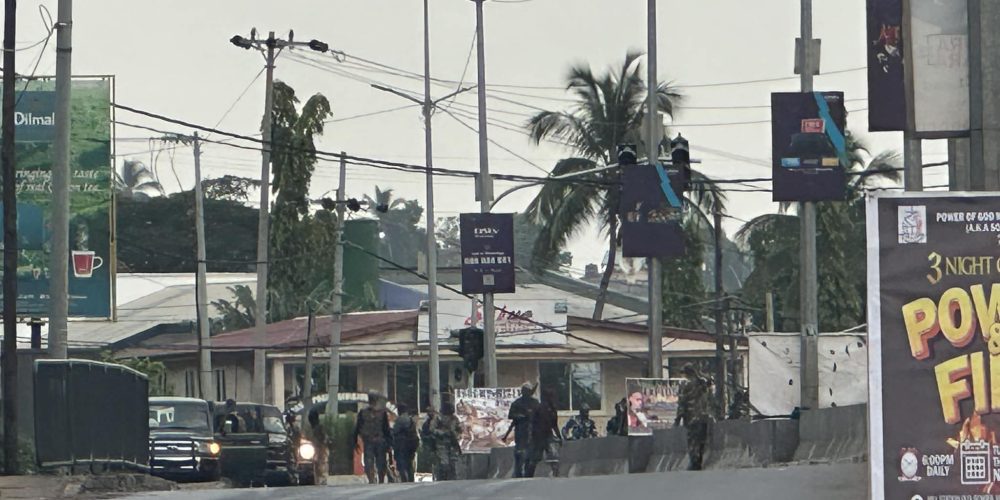
What happens on Sunday 26th November 2023 at Wilberforce Military barracks in the capital of Freetown Sierra Leone that is referred to as a security breach which took the lives of gallant security personnel both in the military and police force and a prison break that resulted into a huge number of escapees from prison detention“did not happen in vacuum”it happens as a result of the division in the military and police force through tribal lines, regional and party loyalist and has create a huge security threat across the city of Freetown and also the disturbance of business activities in and out of free town, the issue that lead to the scampish behavior of some unpatriotic officers in the military force has started way back since after independent in the administration of Sir Milton Margai and Albert Margai that brought their military tribal men into the realm of politics to serve in strategic government positions in other to protect their interest and remain in power and same happens in the Sheka Proven Stevens administration and the Ernest Bai Koroma led administration, that is why the Bio Administration find it difficult to distance the military away from involving/participating into state politics even though measures have been put in place by the Bio led administration to reform the military but yet still it difficult and It is now the responsibility of every Sierra Leonean to work together to change the country’s negative outlook to a positive one. Together, as a country, we can create a unity woven from our varied experiences. United, we possess the ability to overcome obstacles, welcome optimism, and construct a future in which every voice becomes an integral part of our country’s vibrant fabric. We can make Sierra Leone more inclusive and prosperous for future generations by working together and showing empathy for one another and respect/pray for the head of state.
Going further;
The government most create a well-equipped and well-armed military and paramilitary force to counter insecurity threats, and station armed forest guards with state-of-the-art monitoring tools.
To prevent unauthorized people from entering the nation, station civil and armed border guards with cutting-edge surveillance equipment.
Actionable security intelligence is imperative.Real security intelligence needs to be useful to the state. Security intelligence aims to provide actionable data that informs and targets the implementation of security controls and countermeasures, rather than just gathering and archiving more data that is of irrelevance to the state.
Physical security is essential anytime there is a big crowd of people present, such as at a concert, parade, sporting event, corporate function, fundraiser, or a variety of other events. For what reason? A security breach could potentially target any of the numerous moving components that make up an event. An important part of keeping people safe and out of harm’s way is identifying these threats in advance.
The writer *Santigie Abu Kamara is a
Lecturer at IPAM – University of Sierra Leone
Copy right –Published in print in Expo Times Newspaper on Monday, December 4th, 2023 (ExpoTimes News – Expo Media Group (expomediasl.com)