




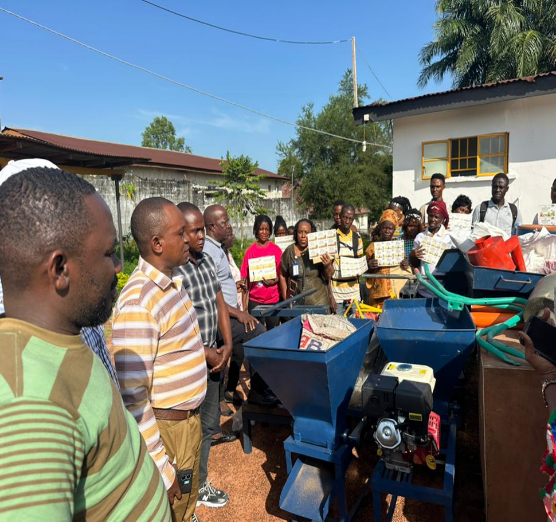
Solidaridad West Africa in Sierra Leone has supported more than 200 smallholder women farmers, organized into 75 groups across Bo, Kenema, and Moyamba Districts, with agro-processing machines and essential agricultural equipment.
The support, provided under the Resilient Food and Nutrition Security (RFaNS) Programme, supported by The Church of Jesus Christ of Latter-day Saints—targets women farmers who previously benefited from assistance to cultivate cassava, orange-fleshed sweet potatoes, rice, and assorted vegetables. The intervention aims to increase agricultural production, improve packaging, add value to locally grown crops, reduce post-harvest losses, and ultimately boost household incomes.
The items distributed include grinders, dryers, rice mills, gari processing machines, and blenders. Beneficiary groups were also supported to develop branding and promotion strategies to strengthen the visibility and market access of their processed products.
Speaking on the initiative, Andrew Kojo Morrison, Country Representative of Solidaridad in Sierra Leone, said the RFaNS programme is designed to enhance productivity, competitiveness, income, and sustainability among smallholder farmers.
He added that the intervention builds on achievements from previous phases of the RFaNS programme by strengthening market linkages, improving access to agricultural inputs, and supporting existing production systems and enterprises.
Key value chains under the project include vegetable and rice production, small livestock rearing, nutrition and homemade baby food processing, as well as access to finance through Village Savings and Loan Associations (VSLAs).
Morrison highlighted the transformative impact of the partnership, noting that more than 2,000 smallholder women farmers have benefited from improved seeds, fertilizers, organic pesticides, agro-processing equipment, and technical support through RFaNS.
“This partnership with The Church of Jesus Christ of Latter-day Saints has transformed the lives of women farmers in Sierra Leone,” he said.
“The support goes beyond agriculture. Through our farm-to-nutrition approach, mothers use crops like orange-fleshed sweet potatoes, vegetables, and rice to prepare nutritious meals for their children at home. Pregnant and lactating mothers no longer depend on expensive supplements but rely on their harvest to produce nutrient-dense foods, significantly reducing malnutrition.”
The programme has supported women to grow, process, and produce life-saving nutrition independently; creating a sustainable and empowering cycle that secures brighter futures for mothers and children in Sierra Leone.
Before distributing the agro-processing machines, Solidaridad, in collaboration with the Ministry of Agriculture and Food Security (MAFS) in Bo, trained smallholder women farmers and processors from Bo, Kenema, and Moyamba districts on how to use the equipment under the RFaNS IV Project.
The training, conducted by Aminata Bah, Senior Programme Officer at Solidaridad, and Engineer Nabieu Kamara from MAFS at Unity Hall, Bo Town, provided hands-on skills for women’s groups—most of whom are beneficiaries of the RFaNS Programme—on how to operate rice mills, gari processing machines, blenders, and other key machines.
Aminata Bah explained that smallholder farmers often face post-harvest losses, limited access to modern processing technologies, and poor packaging solutions. To address these challenges, Solidaridad is equipping women with both modern processing equipment and practical training to improve product quality, expand market access, and increase income.
“Providing modern processing and packaging equipment helps reduce post-harvest losses, improve food quality, and boost local production. One of our main strategies is to strengthen local value chains, especially in processing and packaging agricultural products,” she said.
Engineer Nabieu Kamara from MAFS said the training covered the operation and maintenance of cassava and rice processing machines.
“With this training, the women are now equipped to operate and carry out basic maintenance of the machines that will be installed in their various communities. This will increase their productivity and reduce the challenges of using traditional processing methods,” he said.
He added that the support will boost rice and cassava production and encourage women to expand their farms.
“If more women receive support like this from Solidaridad, Sierra Leone can move closer to becoming a food-secure country,” Kamara remarked.
Isatu Sesay, Coordinator for National Federation of Farmer in Sierra Leone in Bo District, thanked Solidaridad on behalf of the NAFF-SL and the ministry of Agriculture and Food Security.
He extended his heart felt gratitude to Solidaridad highlighting the long support that she has and other women farmers have received from the Solidaridad over the years.
“We have received a lot of training for example training on preparing nutritious food using local recipes, farm management, Village Savings and Loan Association Management Training, through different projects implemented by Solidaridad in Sierra Leone over the Years.
She mentioned that the support with machines means more production, processing and packaging of agricultural products for different market. ‘The support will address the challenges that farmers had to process their rice, cassava for examples into finished products.
“This support is a milestone to development in the lives of these women that received support from Solidaridad citing specific communities in Bo, Kenema and Moyamba. The processing machines will boost the processing and packaging of local made products.’
Momoh Kamara, District Monitoring and Evaluation Officer at the Ministry of Agriculture and Food Security in Bo, thanked Solidaridad for empowering women farmers under the RFaNS Project. He encouraged the beneficiaries to make the most of the opportunity to increase food production in their communities.
He also noted that the support aligns with Pillars 1, 3, and 6 of the Government of Sierra Leone’s Feed Salone Programme, the national strategy to address food security challenges.
“This intervention supports women to process their agricultural products and link them to markets, which is vital for improved production and sustainability,” he said.
The support also falls under Pillar Six – Empowering Women and Youth, which promotes food security and creates employment opportunities for women and young people. These pillars collectively aim to transform Sierra Leone’s agricultural sector, increase food production, and boost export earnings.
The Resilient Food and Nutrition Security Programme is improving food and nutrition security among vulnerable households. The initiative has focused on boosting agricultural productivity, expanding access to nutritious food, and strengthening community resilience to food insecurity.
Through targeted training, resource distribution, and strong community engagement, the project has reached many households, contributing to measurable increases in both food production and dietary diversity.
Copyright –Published in Expo Times News on Friday, 5th December 2025 (ExpoTimes News – Expo Media Group (expomediasl.com)