




By Chernor M. Jalloh
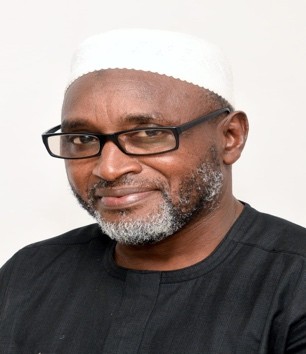
“When hard work is mistaken for malpractice, and brilliance is treated as evidence of guilt, a nation begins to betray its own future. The widespread withholding of results by WAEC-Sierra Leone has turned merit into suspicion—punishing excellence, frustrating parents and educators, and eroding the very foundation of trust upon which true education and nation-building depend.” Chernor M. Jalloh
In recent examination cycles in Sierra Leone, thousands of students who sat the West African Examinations Council (WAEC)-administered exams—both the Basic Education Certificate Examination (BECE) and the West African Senior School Certificate Examination (WASSCE)—have found their results abruptly withheld. While this decision is ostensibly taken in the name of integrity, it is instead undermining public trust, penalising diligence, and stifling academic ambition. For a nation striving to build its human capital, the consequences extend far beyond domestic frustration—it is a deep wound to Sierra Leone’s educational promise and its future development.
The Numbers Tell a Troubling Story
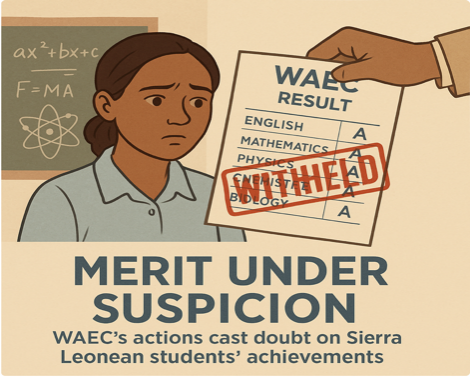
In the 2025 BECE cycle, over 2,500 candidates had their results withheld or retained because of alleged administrative or malpractice issues—including 1,673 students whose entire results were detained. In the same year’s WASSCE, the Ministry of Basic and Senior Secondary Education (MBSSE) confirmed that 13,213 candidates had their results withheld, with more than 3,500 cases linked to unpaid school fees. The year before, the figure was even more staggering: roughly 27,000 results withheld across the country.
These are not mere statistics—they are shattered dreams and suspended futures. Many candidates, teachers, and parents have voiced deep frustration. “My parents paid all the fees, and I studied really hard. Now I don’t even know what went wrong,” lamented one pupil from Wellington, Freetown. In another case that stirred public outrage, the results of a 45-year-old female candidate, who sat nine subjects including English, Further Mathematics, and Physics, were withheld without explanation.
Behind these cases lie countless families who have invested years of savings in extra classes, private tutoring, and weekend study sessions—only to see success treated with suspicion. The perception that high performance, especially in science subjects, could automatically invite investigation or cancellation is both demoralising and damaging.
When Excellence Is Treated as Evidence
Sierra Leone’s education landscape is filled with parents, teachers, and school proprietors who work tirelessly to uplift academic standards. Private schools, in particular, have introduced extra evening lessons in core subjects like English Language, Mathematics, Physics, Chemistry, and Biology to strengthen student performance. Yet, many now fear that outstanding results—especially straight A’s—might be interpreted as evidence of malpractice rather than mastery.
Consider the irony: the child of a university lecturer or a nurse, whose parents have supervised every stage of their learning and paid for extra coaching, may see their success questioned precisely because it seems “too good to be true.” In effect, the system risks punishing the very behaviours it should promote—discipline, effort, and intellectual curiosity.
For school proprietors, the situation is equally frustrating. Reputations are at stake. When results are withheld en masse, schools that have legitimately produced brilliant students find themselves tarnished, their credibility questioned, and their admissions undermined.
The Broader Damage to Nation-Building
The withholding of results on a massive scale is not a procedural hiccup; it is an assault on three critical pillars of national development—meritocracy, human capital, and institutional trust.
- Meritocracy: A fair education system must reward diligence and competence. When exceptional performance is met with suspicion, students internalise the wrong lesson—that effort does not necessarily yield reward. This corrodes the moral foundation of learning.
- Human Capital: Sierra Leone’s aspirations for industrialisation, innovation, and global competitiveness depend on producing a generation of thinkers, scientists, and entrepreneurs. Undermining the credibility of examinations discourages enrolment in challenging disciplines, weakens motivation, and slows the country’s intellectual progress.
- Institutional Trust: WAEC and MBSSE are custodians of educational credibility. When thousands of results are withheld without timely, transparent explanations, confidence in public institutions erodes. Parents begin to doubt, schools lose morale, and students lose faith in the fairness of the system itself.
Towards a Fairer System
To restore trust, the response must be swift, structured, and transparent. Several policy interventions can make an immediate difference:
- Publish disaggregated data on withheld results.
WAEC and MBSSE should release a public report after every examination cycle, showing how many results were withheld, and for what specific reasons—distinguishing between confirmed malpractice, administrative errors, and fee arrears. Transparency deters cheating and dispels unfounded rumours. - Establish time-bound reviews and appeals.
There must be a defined window—no longer than 30 days—for all withheld results to be investigated and resolved. Candidates and schools should have a formal right to appeal, supported by a clear explanation of the alleged irregularity and access to evidence where appropriate. - Separate malpractice from maladministration.
Not all withheld results stem from cheating. Many are due to missing Continuous Assessment Scores (CASS) or technical registration issues. In 2025, for instance, over 500 BECE candidateslost results because their schools failed to submit CASS data on time. Administrative lapses should not condemn students to silence and shame. - Introduce a candidate results-tracking system.
WAEC should develop a digital results portal that allows candidates to check the status of their withheld results in real time—“Under Review,” “Awaiting School Confirmation,” or “Pending Payment.” Such transparency would reduce anxiety and speculation. - Protect legitimate excellence.
No student’s result should be withheld merely because their performance defies statistical expectations. Investigations must be evidence-based, not assumption-driven. High achievers deserve recognition, not suspicion.
Restoring Honour to Achievement
The moral argument is simple yet profound: behind every withheld result stands a human being—often a child whose parents sacrificed to afford school fees, transport, and tutoring. To detain that result unjustly is to betray that sacrifice and to wound the very soul of education.
A society that doubts its brightest minds erodes its future. By contrast, nations that champion merit—like Ghana and Rwanda—have demonstrated that it is possible to uphold integrity while protecting fairness. Ghana’s digitised WAEC verification and Rwanda’s transparent results appeals board are practical models Sierra Leone could adapt.
Conclusion: From Suspicion to Celebration
Sierra Leone cannot continue on a path where excellence is equated with guilt. Education remains the backbone of nation-building, and examinations are the arteries through which credibility and confidence must flow. When these arteries are blocked by opaque procedures, the entire system suffers from paralysis.
To rebuild faith, WAEC and MBSSE must act with urgency and openness. Publish the numbers. Clarify the reasons. Shorten the waiting. Respect the students. Above all, celebrate success when it is genuinely earned. Because the next time a Sierra Leonean child earns straight A’s in English, Further Mathematics, Physics, Chemistry, and Biology, the nation should not respond with suspicion. It should respond with applause.
Only when brilliance is celebrated—not withheld—will Sierra Leone truly honour the promise of education as the engine of national progress.
Copyright –Published in Expo Times News on Wednesday, 5th Noverber 2025 (ExpoTimes News – Expo Media Group (expomediasl.com)